
 Hi, I’m Andy
Traveler and photographer.
I don’t travel just to see places. I travel because I want to know if there’s more than just everyday life. More about me
Ayutthaya – Everything About the Most Important Temples in the UNESCO Historical Park
A visit to Ayutthaya is a valuable addition to any trip to Thailand. Even today, you can still sense the glorious era of this former capital city.
A wide variety of ruins, archaeological sites, palaces, Buddhist temples, monasteries, and statues await exploration during your visit to Ayutthaya. The temple complexes are somewhat reminiscent of Angkor Wat, although on a much smaller scale and with considerably fewer tourists.
The temples of Ayutthaya can also easily be explored as a day trip from Bangkok. You’ll find some recommended tours under this link*.
Not in the mood to read? Then explore our Ayutthaya temple photo gallery instead.
What You Can Expect in This Ayutthaya Temple Travel Guide:
Historical Background of Ayutthaya
Ayutthaya, the former capital of Thailand and home to its kings, was the centre of power, wealth, and trade for around 400 years (1350–1767). For a long time, the metropolis was considered unconquerable and, until 1767, ranked among the largest cities in the world.
At the height of its prosperity, Ayutthaya was home to up to one million inhabitants. With its 375 temples, 94 city gates, 29 defensive forts, and thriving trade network, the city was also highly popular among European merchants and travellers.
However, Ayutthaya’s glorious history came to an abrupt end when the Burmese completely destroyed the city in 1767 following a 14-month siege. The royal capital never fully recovered from this devastating attack.
To restore prestige to the weakened Kingdom of Siam, King Rama I began constructing a new and representative palace and temple complex in Bangkok fifteen years later, laying the foundation for what would become Thailand’s modern capital.
The Temple Complexes of Ayutthaya
The top attractions in Ayutthaya are the temple complexes located within the UNESCO Historical Park. These remarkable historical sites can easily be explored during a day trip, including from Bangkok.
Below, you’ll find an overview of the Ayutthaya temples you can visit within the historical park.
1. Wat Chaiwatthanaram in Ayutthaya
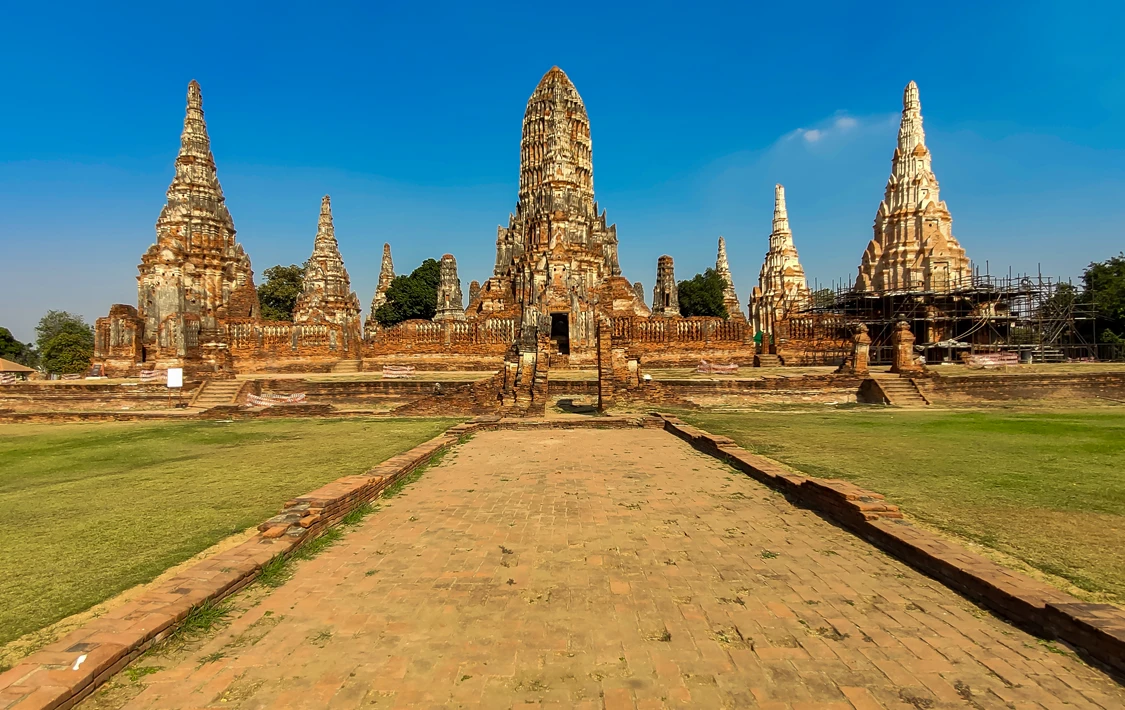

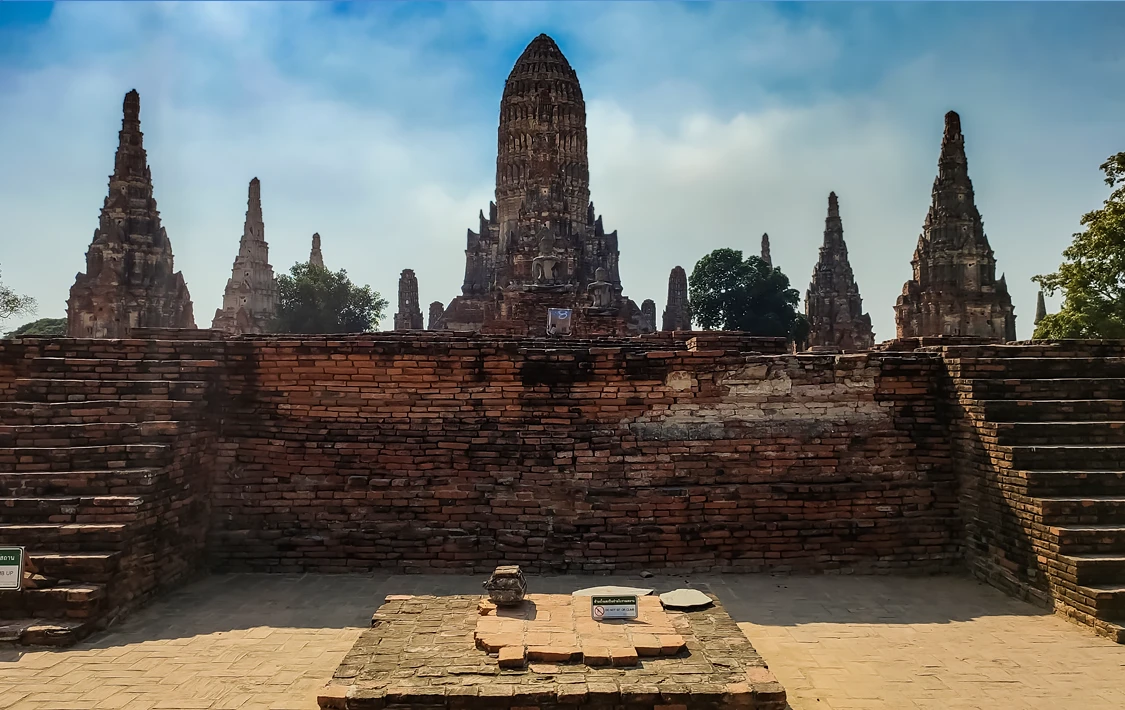
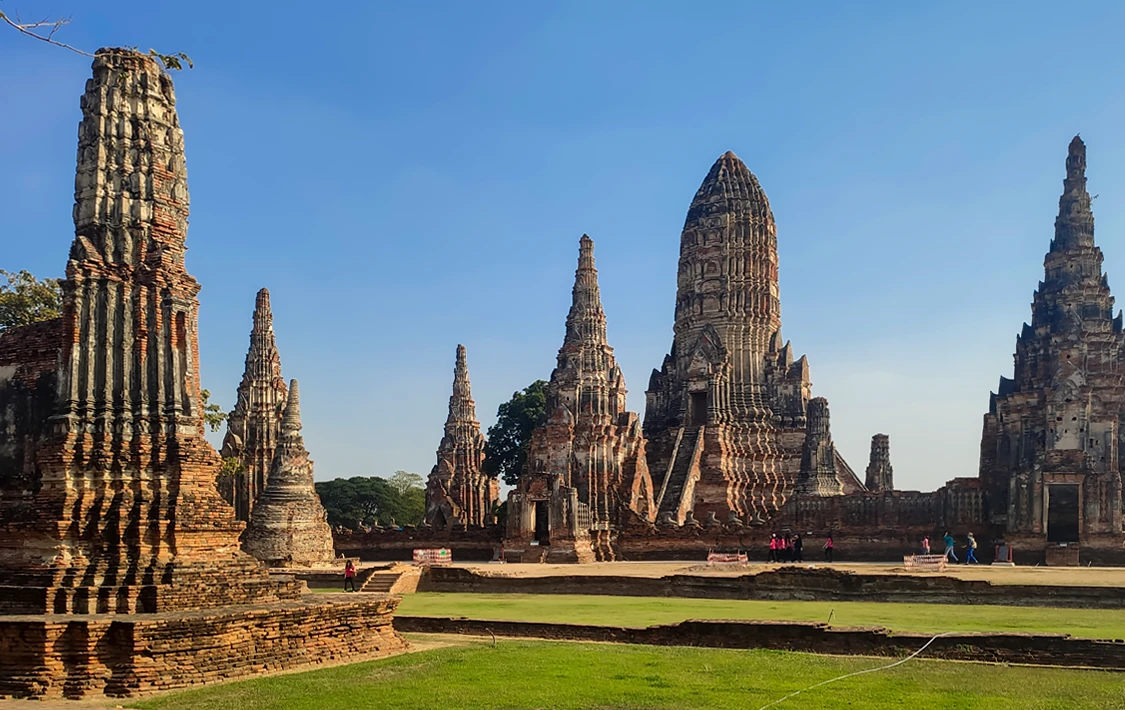
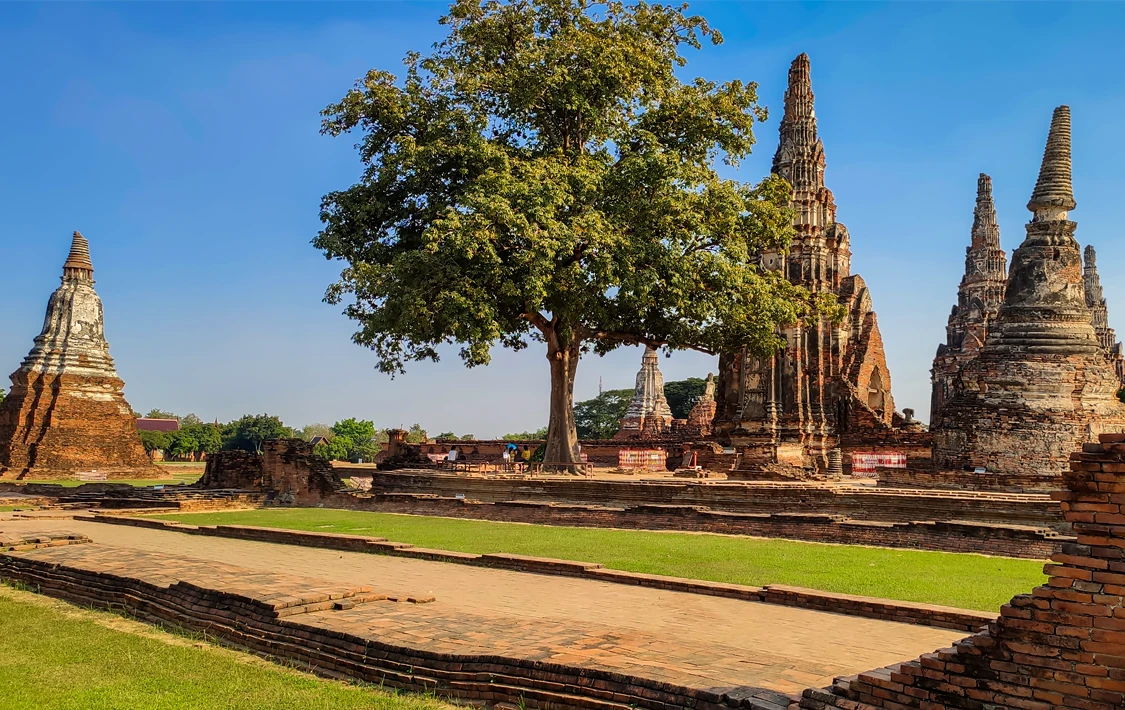
The Wat Chaiwatthanaram dates back to 1630 and was commissioned by King Prasat Thong as the first temple built during his reign, designed in the Khmer architectural style. The temple was primarily used for royal and religious ceremonies. However, Wat Chaiwatthanaram also served as a site for the cremation of deceased princes and princesses. For example, the body of King Boromakot’s son was cremated here.
Built According to the Buddhist View of the Universe
The design of Wat Chaiwatthanaram was inspired by Traiphum Phra Ruang, a literary work from the 14th century describing the Buddhist concept of the universe (The Three Worlds according to King Ruang). The temple complex was architecturally designed to reflect these beliefs.
The 35-metre-high central prang (Buddhist tower) symbolises Mount Meru, regarded as the centre of the universe in traditional Buddhist cosmology. Surrounding it are four smaller prangs, representing the four cardinal directions within the cosmic ocean. The square gallery surrounding the complex symbolises the outer boundary of the world, represented by the eight mountain ranges.
Stunning Location Along the Chao Phraya River
The location of Wat Chaiwatthanaram beside the Chao Phraya River, combined with the impressive scale of the entire complex, gives an idea of the spiritual and majestic atmosphere this Ayutthaya temple once embodied.
A visit to this remarkable temple will most likely leave you equally fascinated.
Useful Information About the Temple
2. Wat Lokaya Sutha
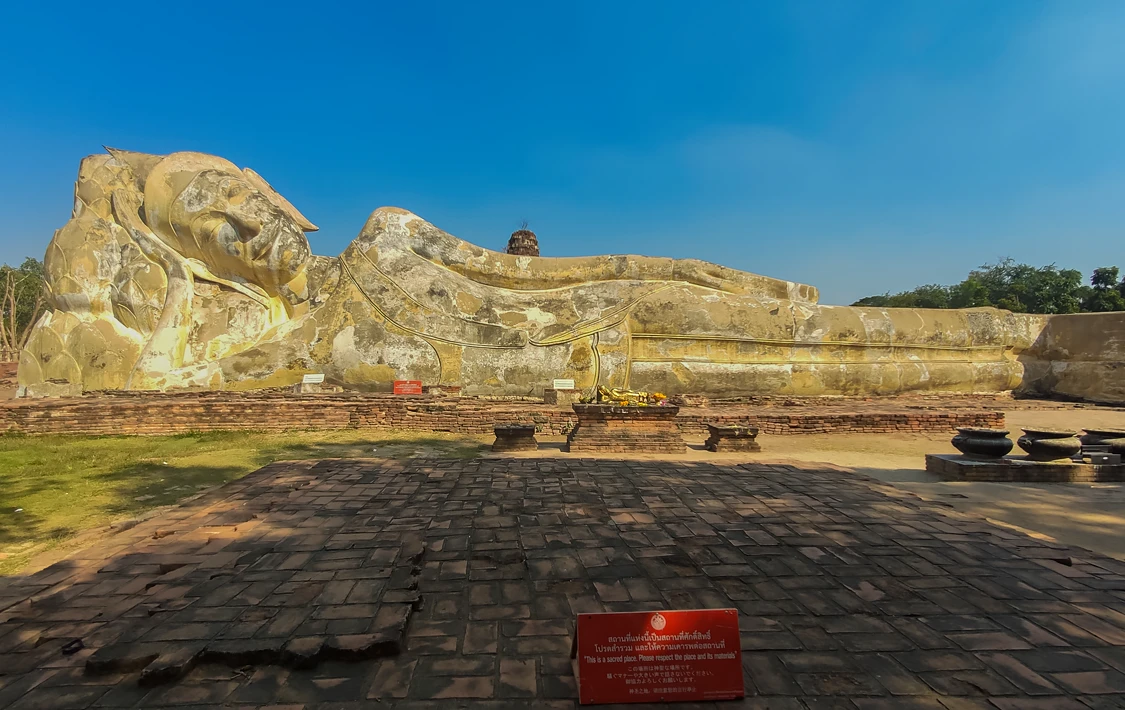
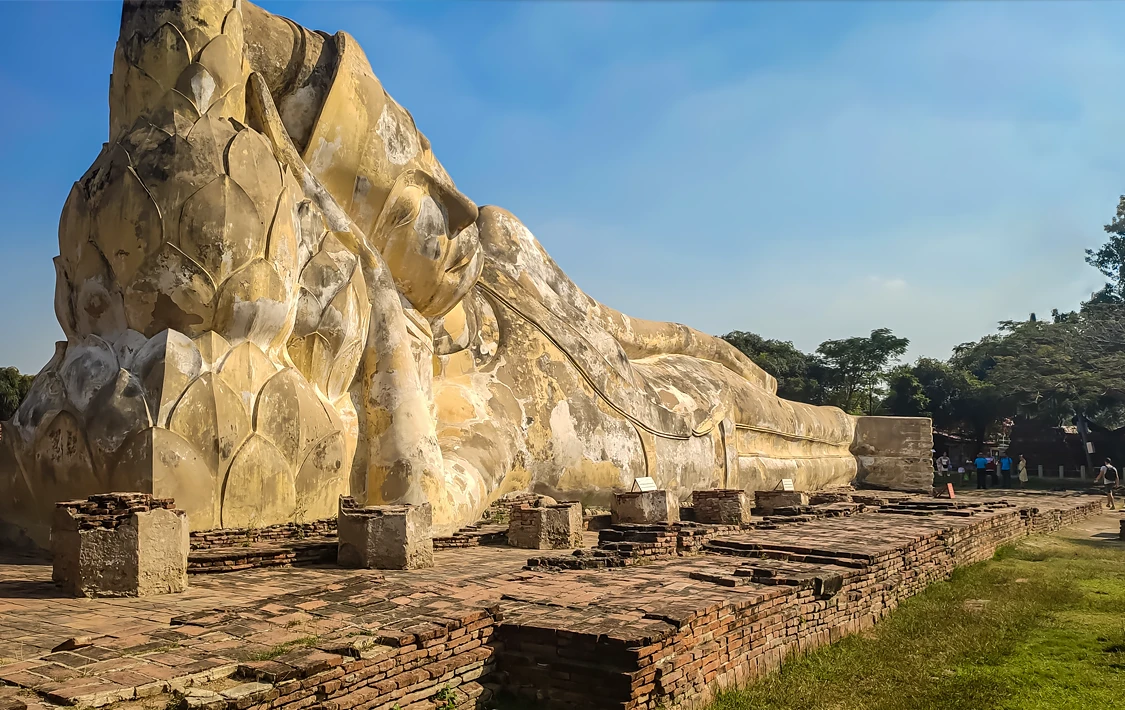
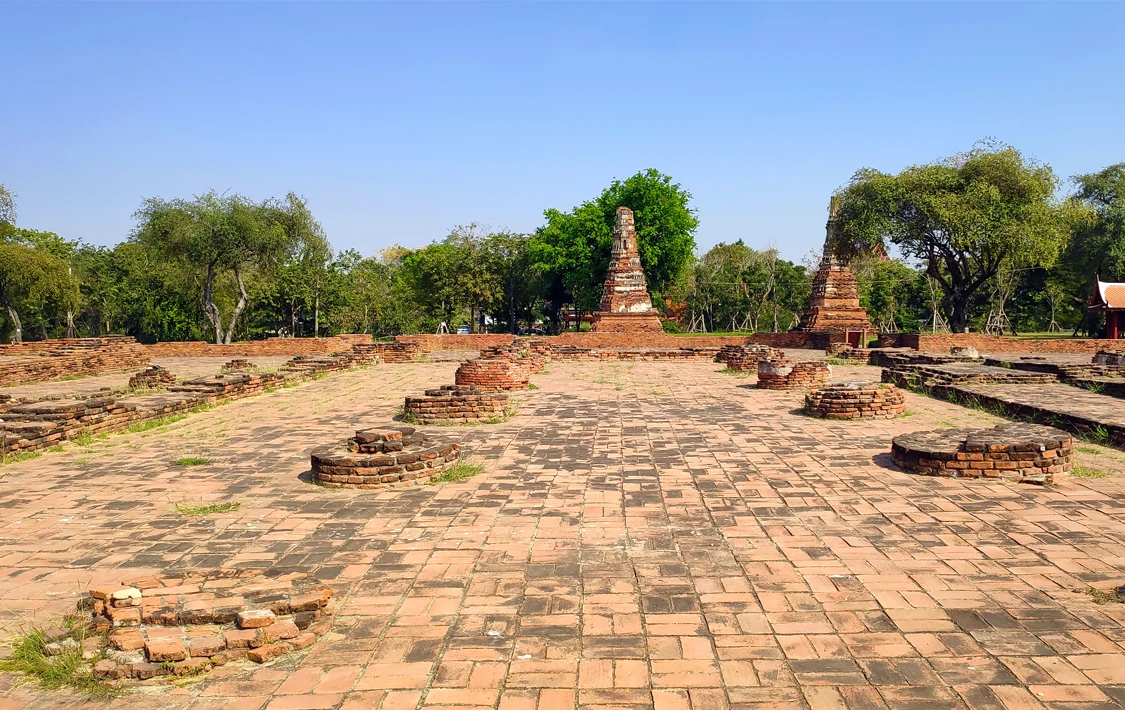
At Wat Lokaya Sutha, only the ruins of the original temple remain today, giving visitors an impression of the temple’s former layout. The exact construction date and founder of the temple are still largely unknown.
The highlight of Wat Lokaya Sutha is its impressive 40-metre-long and approximately 8-metre-high reclining Buddha statue.
Legends Behind Reclining Buddha Statues
Reclining Buddha statues of this size often depict stories from Buddha’s life. According to one legend, the giant Asurindarahu once requested an audience with Buddha. Proud of his enormous size and filled with vanity, the giant refused to bow before Buddha.
In response, Buddha manifested himself in a form many times larger than the giant. He then revealed to Asurindarahu the realm of the Devas (gods) in heaven, whose size surpassed even Buddha’s. Ashamed, the giant Asurindarahu finally bowed before Buddha.
The reclining Buddha at Wat Lokaya Sutha has undergone several restorations, most recently in 1989. Today, the statue is often draped in an orange robe, creating a beautiful contrast against the white-grey brick and plaster remains surrounding it.
Useful Information About the Temple
3. Wat Mahathat Temple in Ayutthaya

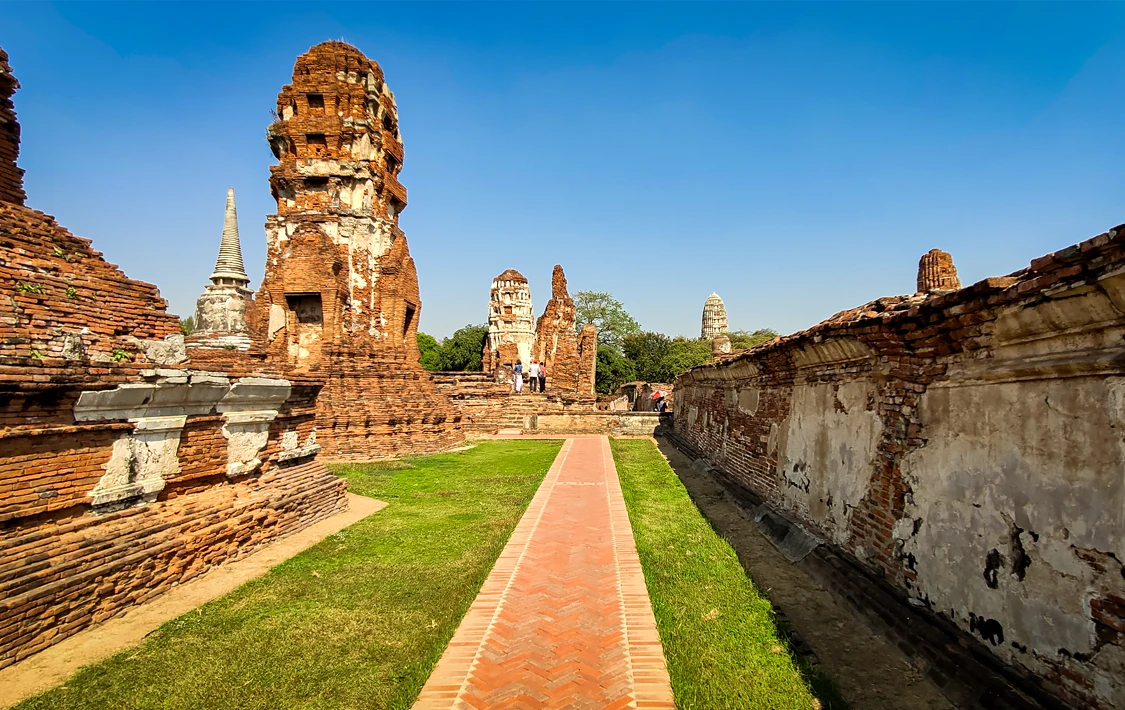
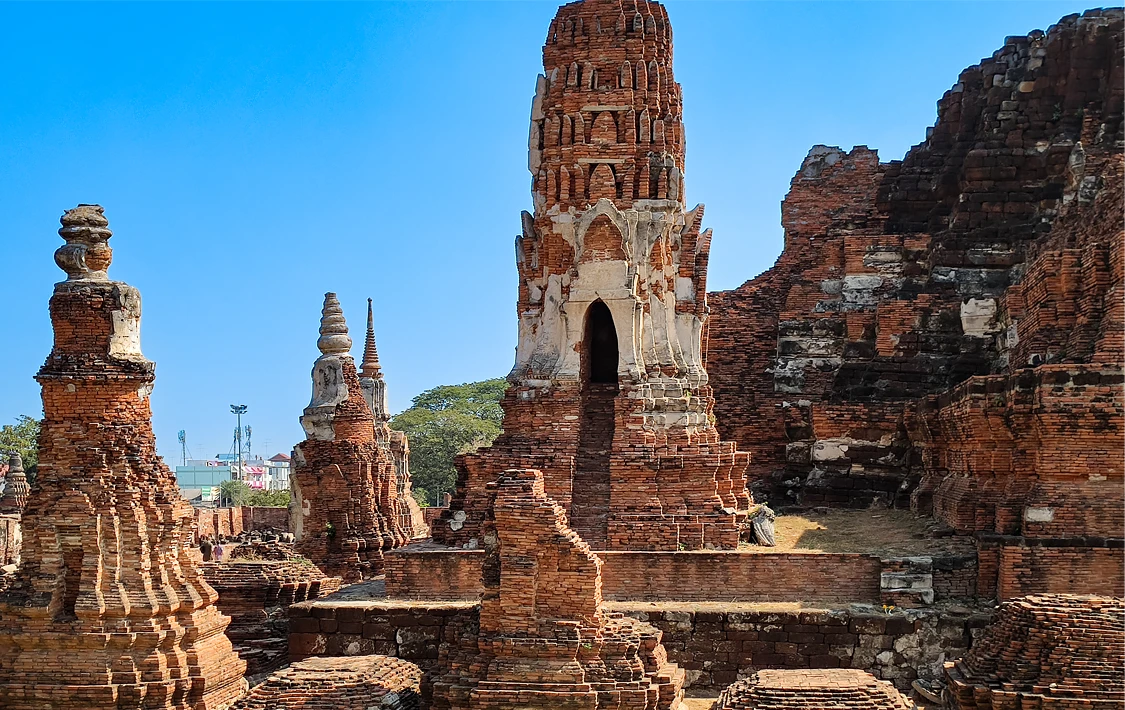

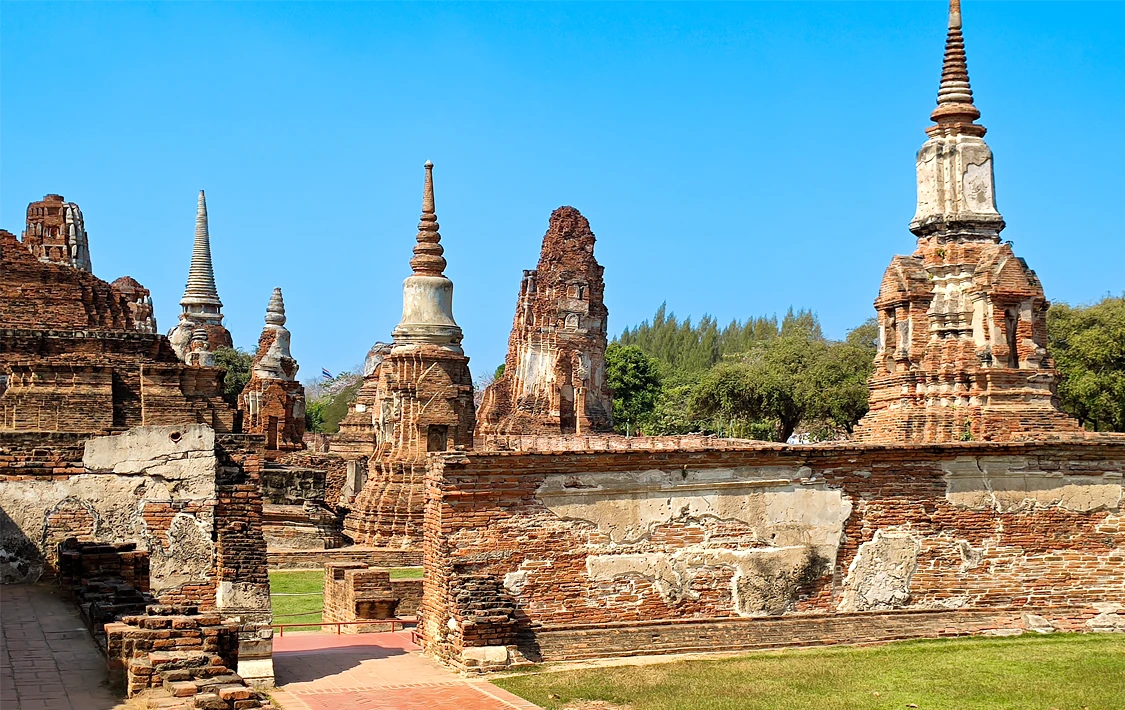
The history of Wat Mahathat dates back to 1374, when King Borommaracha I commissioned the construction of a temple on this site. Over the following centuries, the complex was continuously expanded, renovated, and restored.
At the centre of the temple once stood a 50-metre-high Khmer-style prang (tower), which repeatedly collapsed over time, most recently in 1911. It was never rebuilt, though the ruins remain visible today.
In 1956, extensive restoration work was carried out at the temple. During these efforts, a hidden treasure chamber was discovered beneath the main prang. It contained Buddha relics in a golden urn, several golden Buddha statues, and other valuable artefacts made from gold and precious stones. These treasures can now be admired at the Chao Sam Phraya National Museum in Ayutthaya.
Ayutthaya’s Most Famous Photo Spot Can Be Found at Wat Mahathat
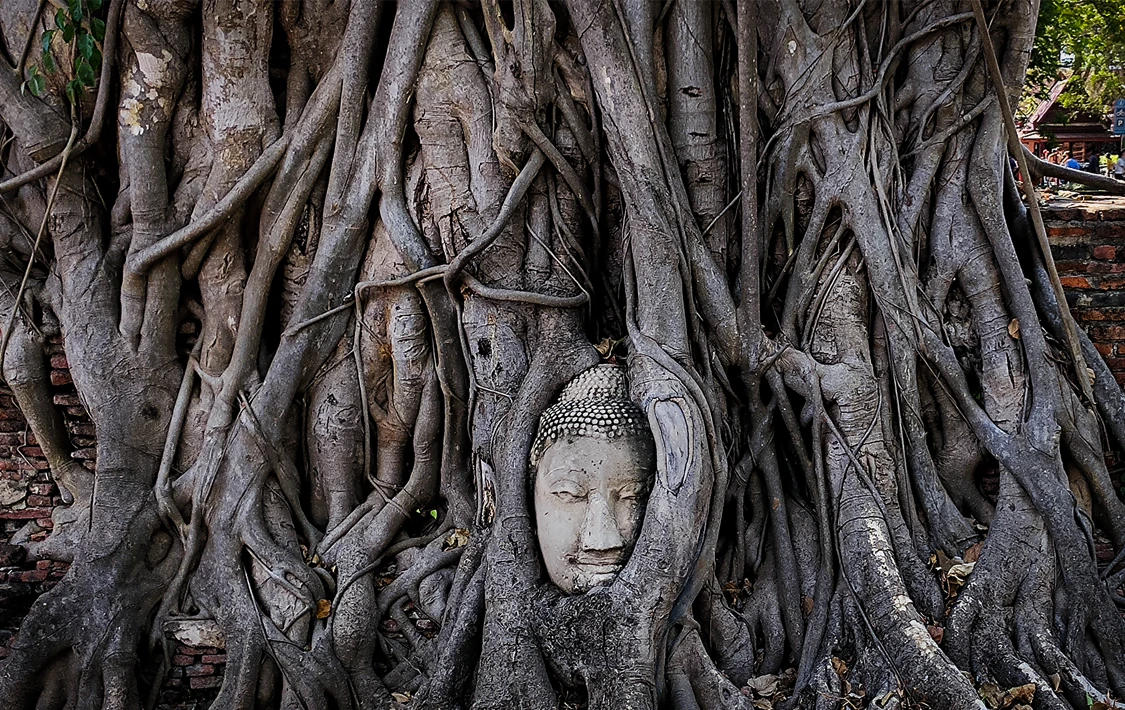
You’ve probably seen photos of a Buddha head entwined within tree roots. This iconic image was most likely taken at Wat Mahathat.
When the Burmese invaded Ayutthaya in 1767, many Buddha statues were decapitated to demonstrate power and dominance. According to legend, monks buried some of the severed Buddha heads to protect them from further destruction.
One of these Buddha heads was buried near a tree. As the tree grew over time, its roots gradually wrapped around the head, bringing it back to the surface. Today, this Buddha head within tree roots has become one of Thailand’s most famous photographic landmarks.
The entire complex covers a large area, where you’ll encounter numerous chedis, decapitated Buddha statues, and impressive ruins. Personally, Wat Mahathat ranks among the most fascinating temples in Ayutthaya Historical Park.
Useful Information About the Temple
4. Wat Ratchaburana Temple in Ayutthaya
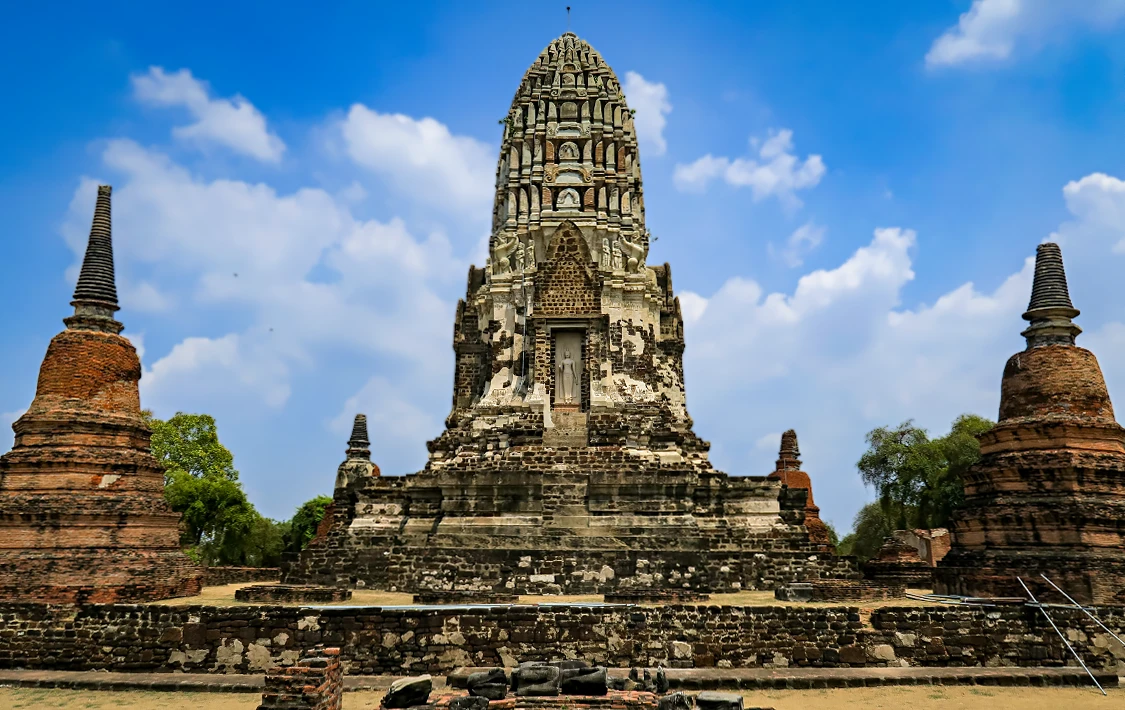

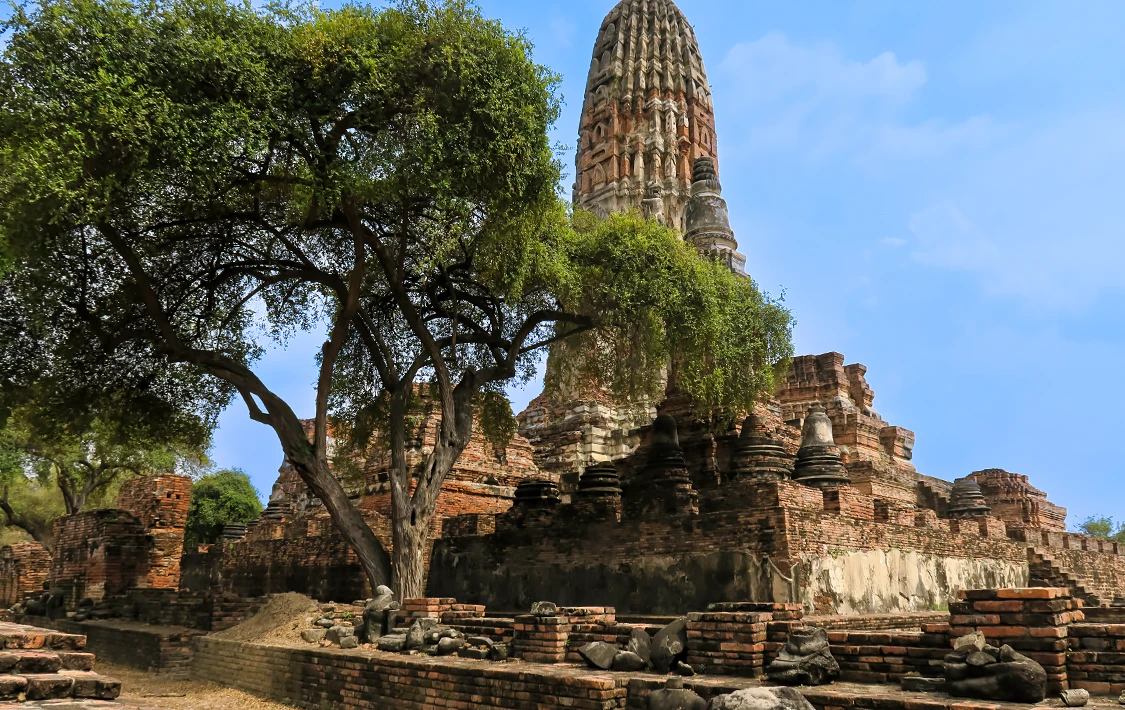
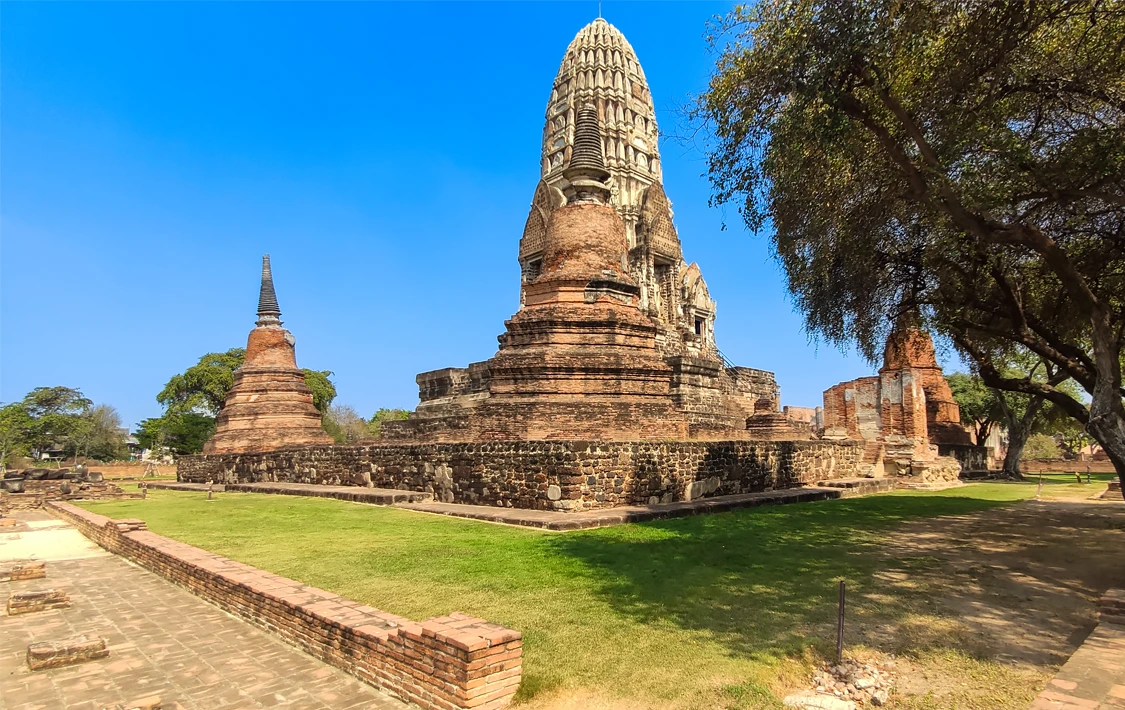
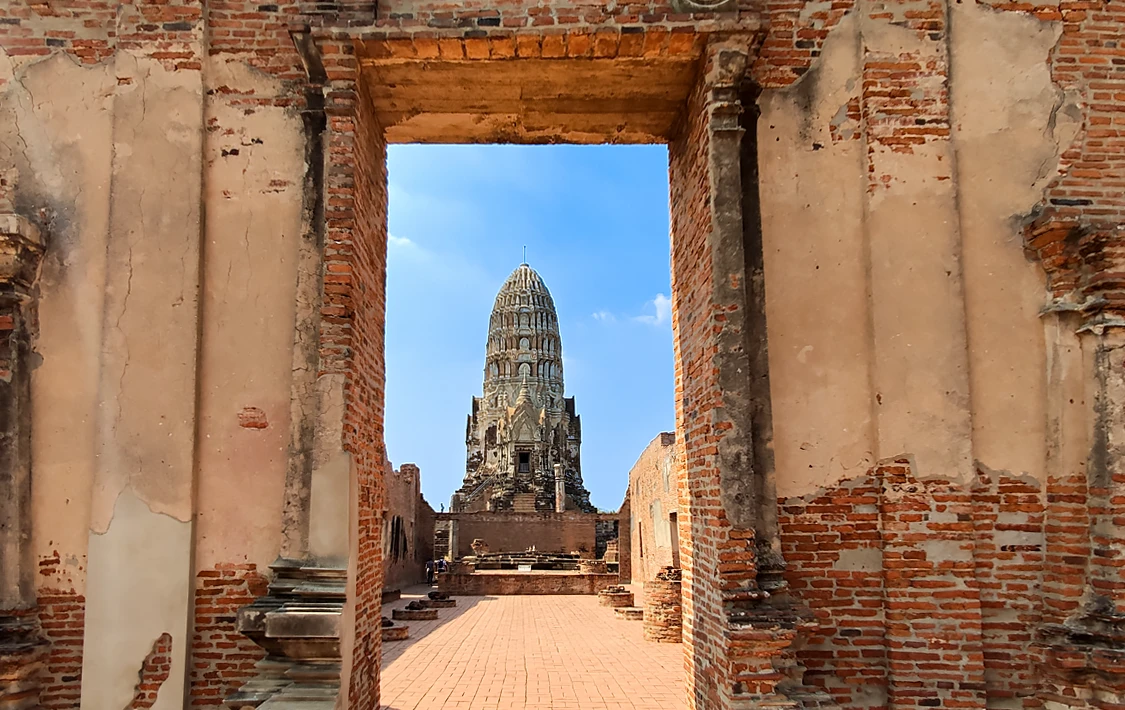
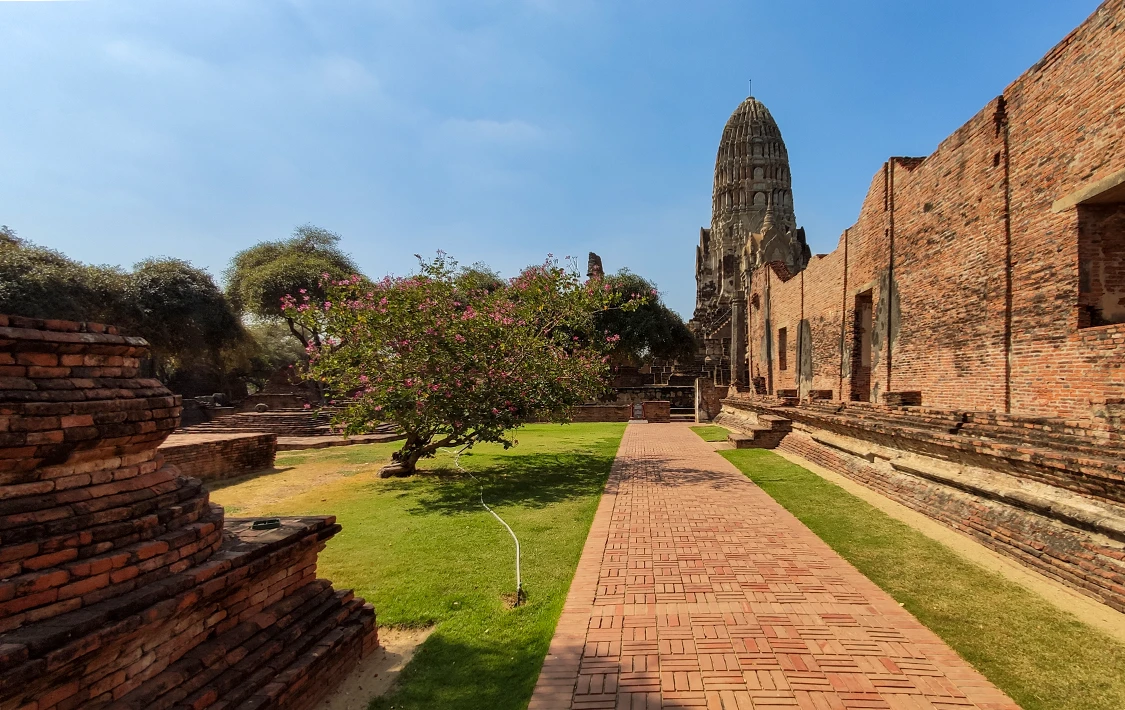
The Wat Ratchaburana Temple is located directly next to Wat Mahathat, almost like its twin temple. From there, you can already spot the large central prang, which is the temple’s main attraction. Several legends and differing historical accounts surround both the origin and construction date of this Ayutthaya temple.
Burial Site of Two Rival Brothers
Officially, the temple is attributed to King Borommaracha II, who is believed to have commissioned Wat Ratchaburana in 1424. According to legend, the temple was dedicated to his two older brothers, who reportedly fought a fierce battle for the royal throne.
Both brothers were killed during this conflict, and Wat Ratchaburana was built to house their ashes and memorialise them.
Phra Prang – The Main Attraction of the Temple
The centrally located and towering Phra Prang (main tower) dominates the entire temple complex and is undoubtedly the highlight of Wat Ratchaburana.
To this day, you can admire impressive decorative details such as Naga serpents, Garuda guardians, and other smaller figures. During renovation work in 1957, archaeologists discovered valuable artefacts, jewellery, and golden Buddha statues hidden within the prang.
Useful Information About the Temple
5. Wat Phra Ram Temple in Ayutthaya
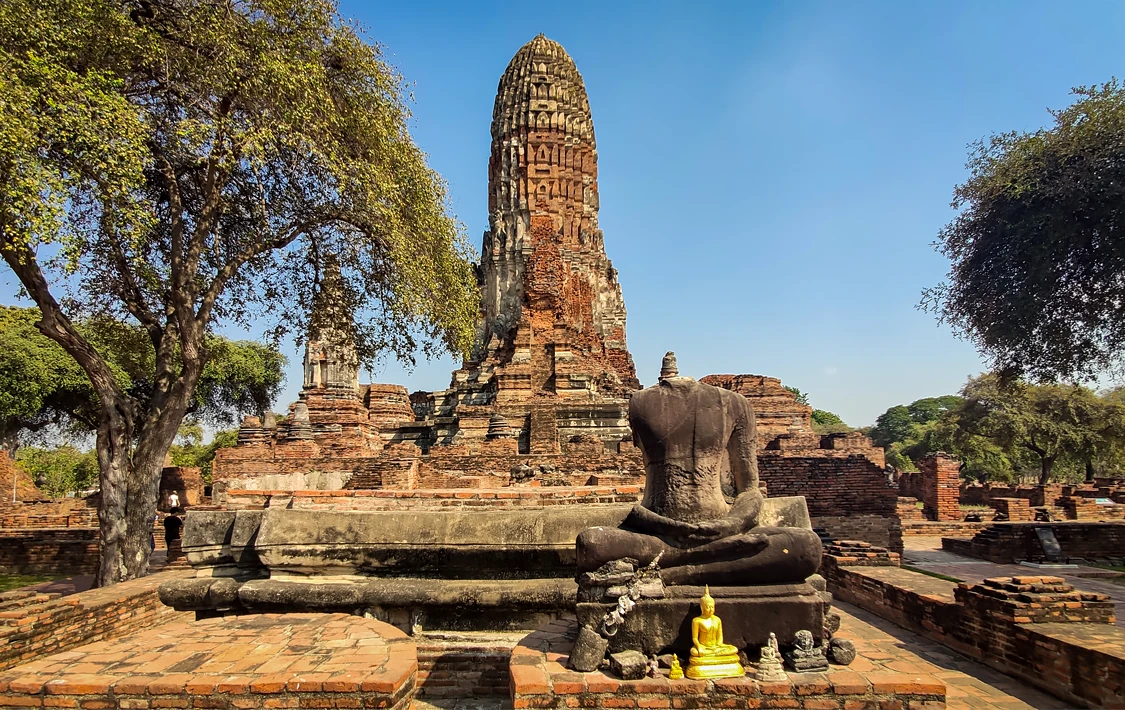
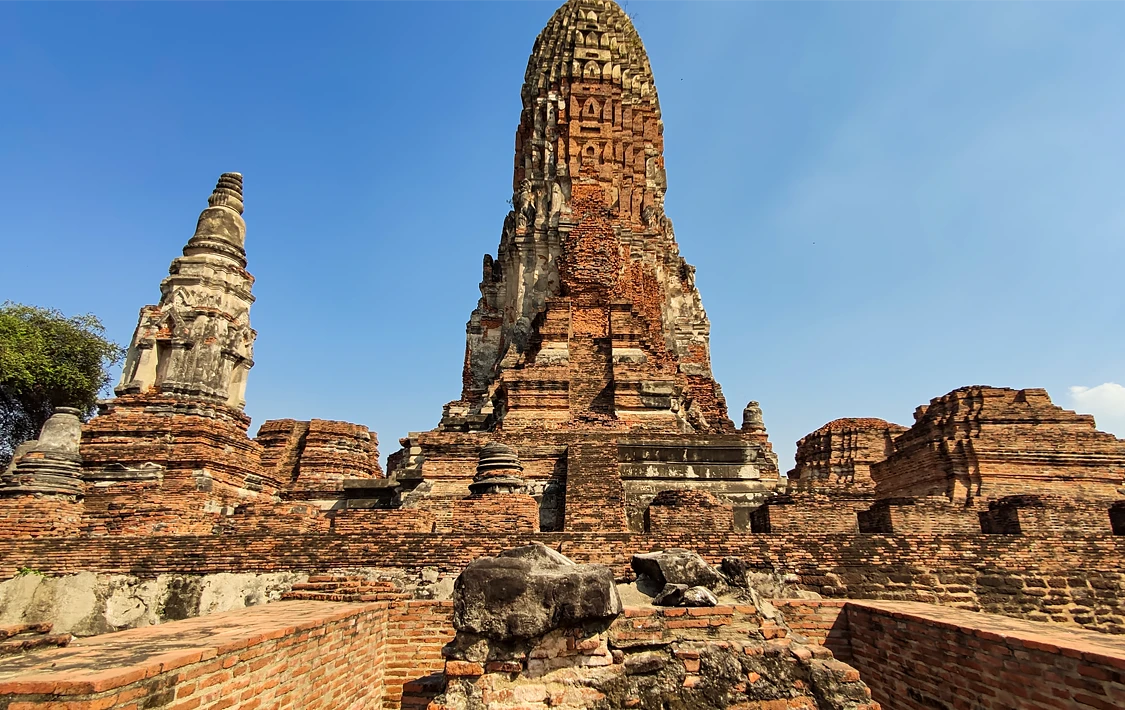
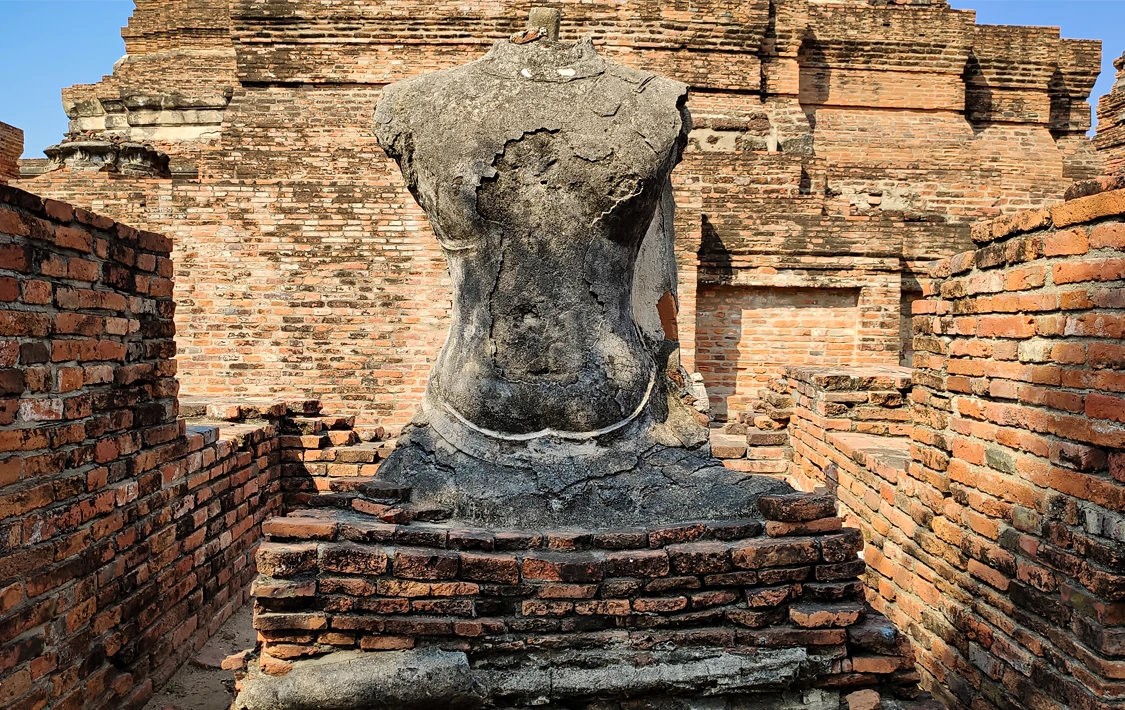
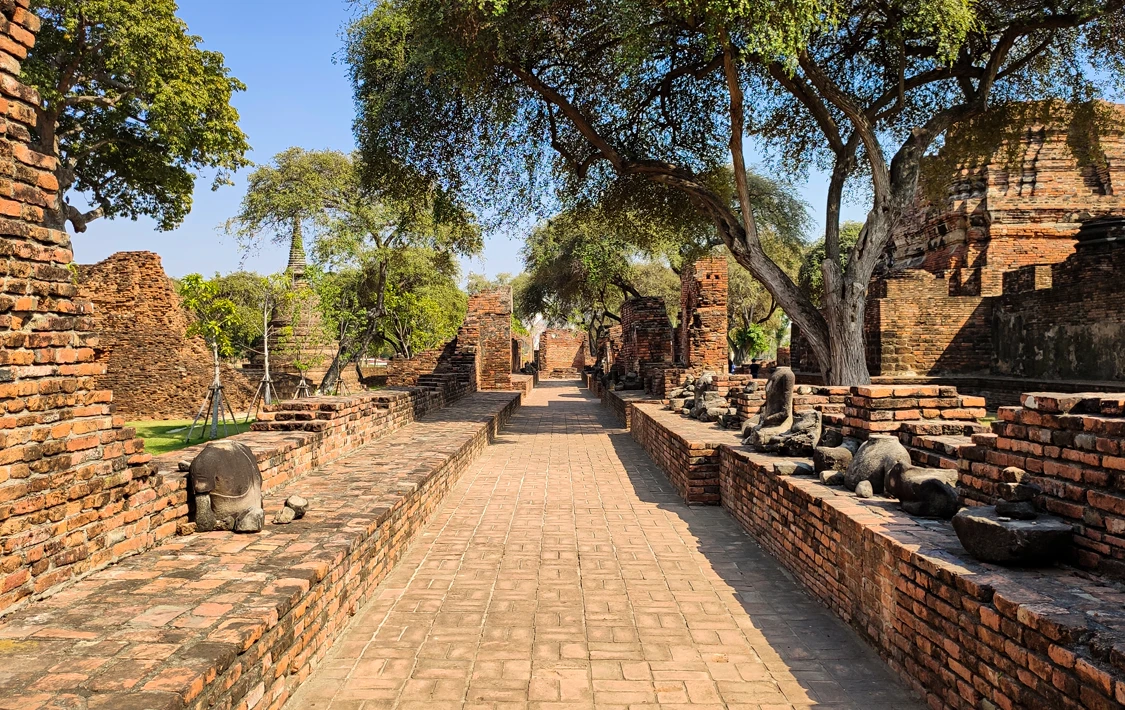

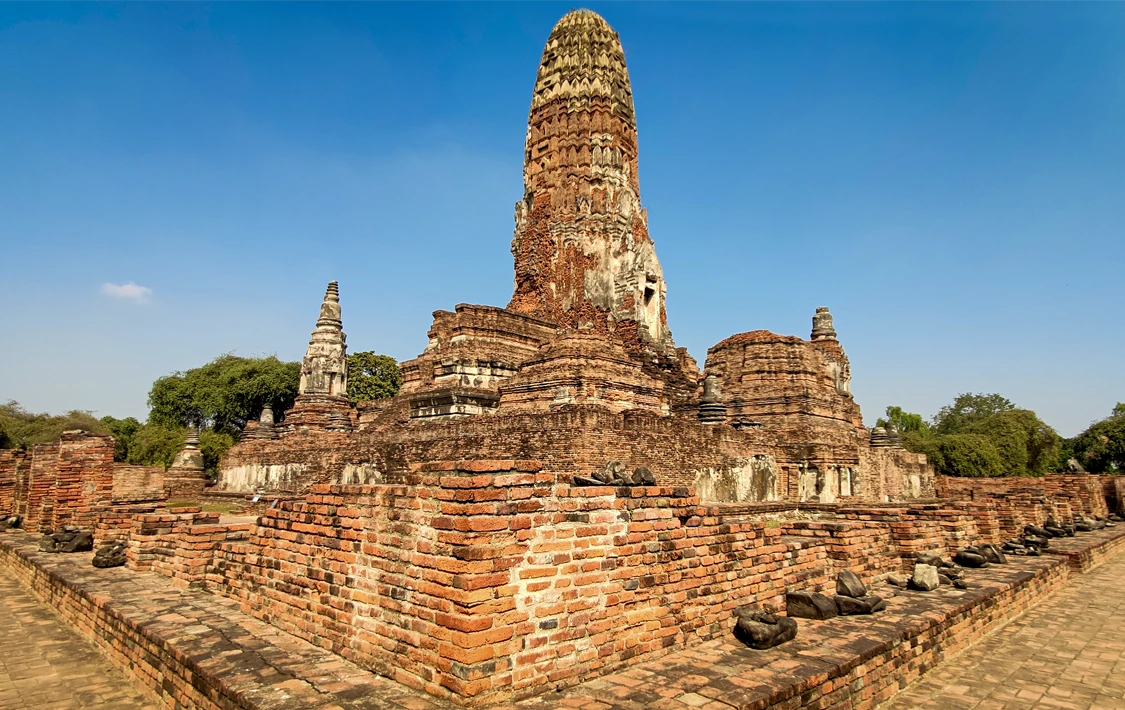
The temple was built in 1369 by King Ramesuan to commemorate the cremation of his father, King Uthong. Even today, the ruins of Wat Phra Ram reveal remnants of the former temple walls, columns of the ordination hall and assembly rooms, as well as several well-preserved pagodas (originally 28), distributed around the central prang.
Although much of the temple lies in ruins, you can still sense its former grandeur and atmosphere. The central main prang (tower) remains remarkably well preserved and serves as the main attraction of Wat Phra Ram.
One of the Quietest Temples in Ayutthaya Historical Park
Wat Phra Ram may not be as impressive as Wat Ratchaburana or Wat Mahathat. However, since most visitors concentrate on those better-known temples, Wat Phra Ram attracts considerably fewer tourists.
Its peaceful atmosphere, green lawns, and shady trees make it an ideal place to slow down and enjoy a quieter side of Ayutthaya Historical Park.
Useful Information About the Temple
6. Wat Phra Si Sanphet in Ayutthaya
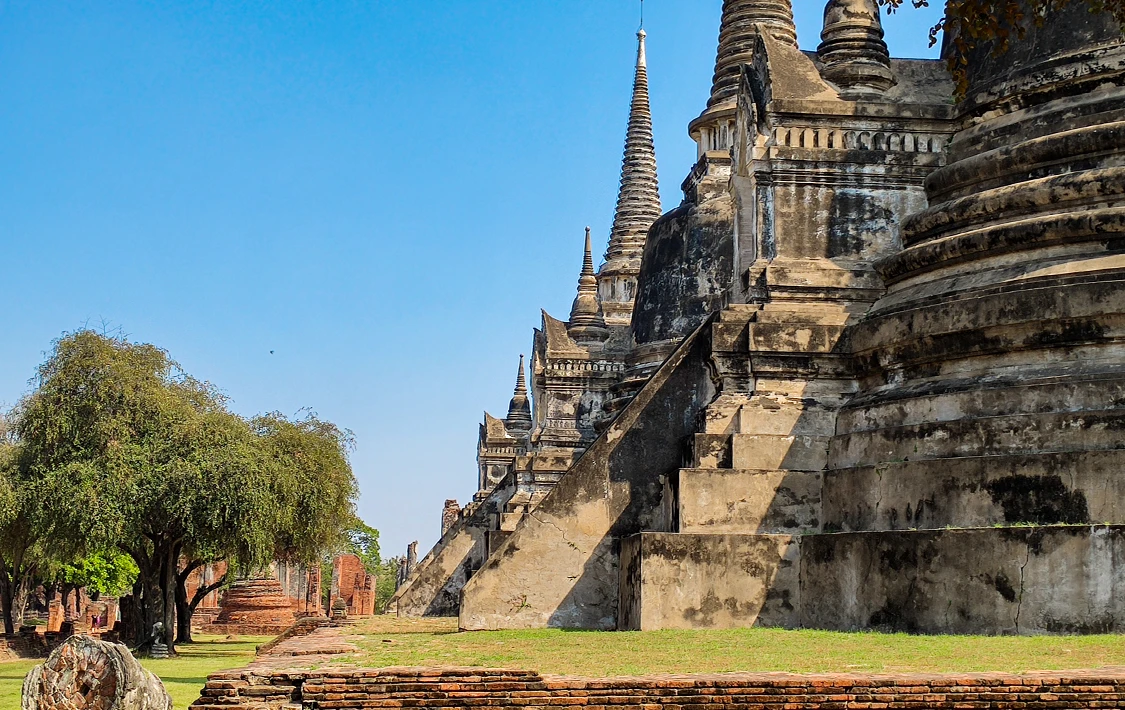

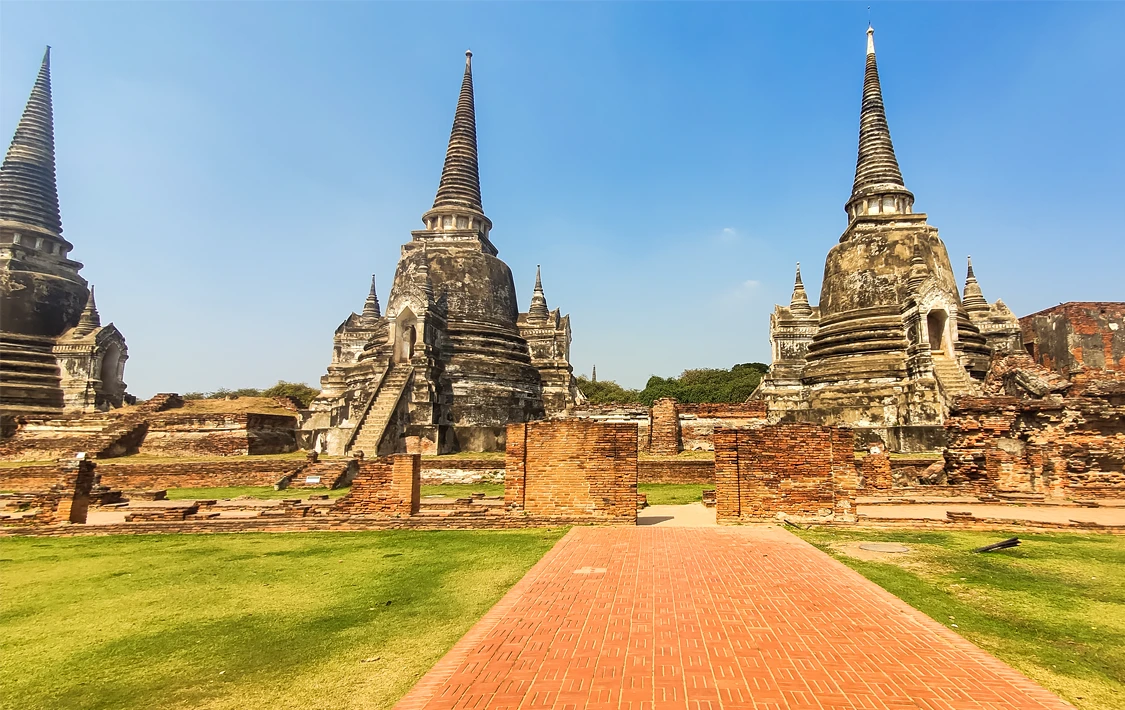
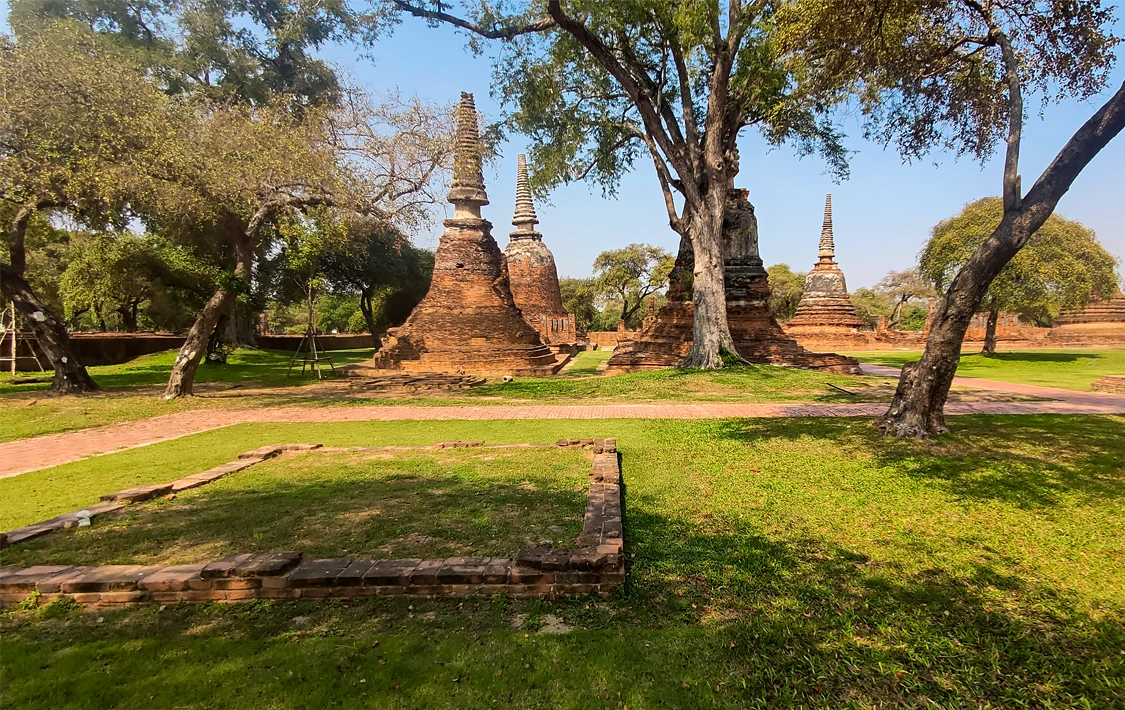
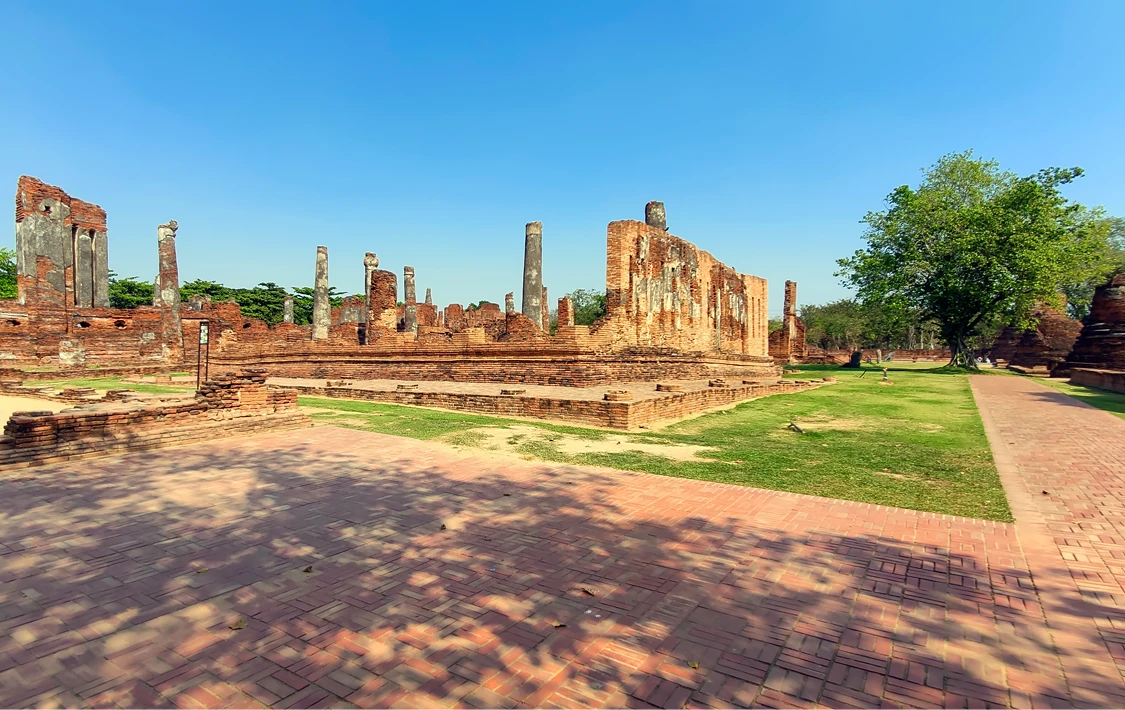
In 1350, King Ramathibodi I built the first Royal Palace of Ayutthaya on the grounds where Wat Phra Si Sanphet stands today. In 1448, King Borommatrailokanat relocated the royal palace further north to construct Wat Phra Si Sanphet on the original site.
The temple was used exclusively for royal ceremonies and did not contain living quarters for monks. Until its destruction by the Burmese in 1767, Wat Phra Si Sanphet was considered the largest and most magnificent temple in Ayutthaya.
After the fall of Ayutthaya, Bangkok became the new capital of Siam, where a new royal temple was later built in the form of Wat Phra Kaew.
The Main Attraction: Three Iconic Chedis
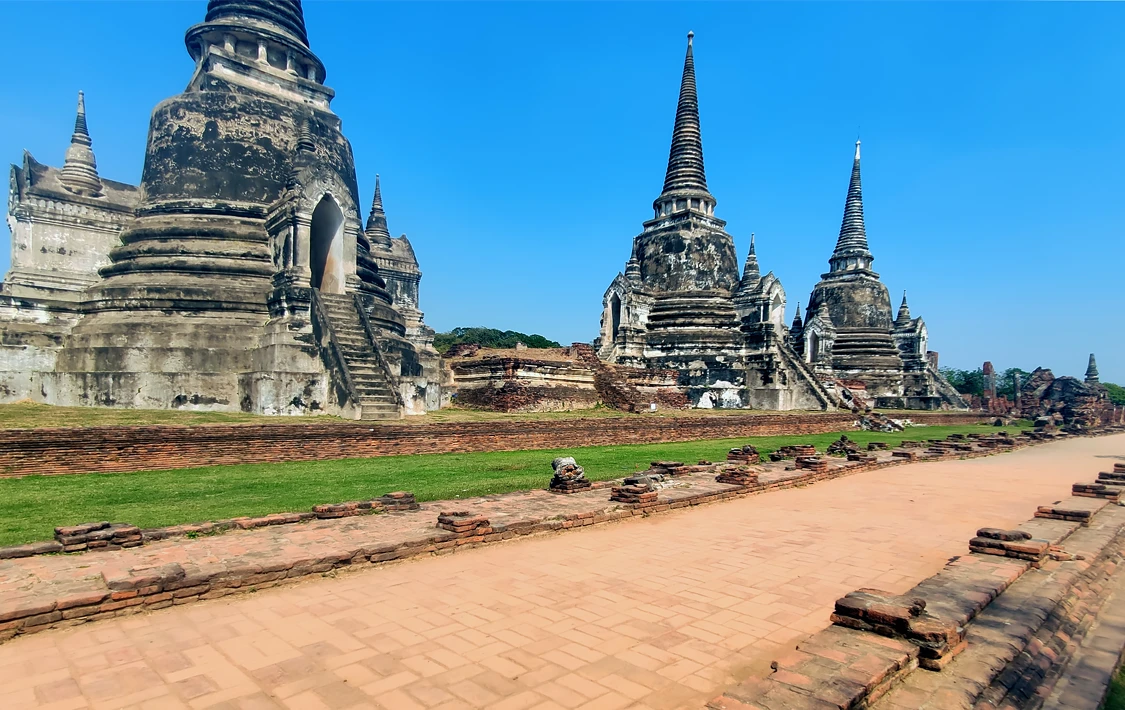
Today, Wat Phra Si Sanphet consists mainly of ruins and remains, with much of the original structure destroyed. At the centre of the complex stands an elevated platform featuring three restored chedis, which are the temple’s main highlight.
These chedis were built in the classic Ceylonese architectural style, resembling large bells. Small chapels were constructed in each cardinal direction, accessible via steep staircases.
The three chedis are undoubtedly the most recognisable landmark of Wat Phra Si Sanphet.
A Walking Route Through the Ruins of Wat Phra Si Sanphet
You can explore Wat Phra Si Sanphet along a beautiful walking route that leads past ruins, towers, ancient walls, and impressive trees, eventually reaching the three main chedis.
This Ayutthaya temple is very popular among visitors, but thanks to the large size of the complex, crowds tend to spread out. As a result, you can usually enjoy Wat Phra Si Sanphet at your own pace in a relatively relaxed atmosphere.
Useful Information About the Temple
7. Wihan Phra Mongkhon Bophit
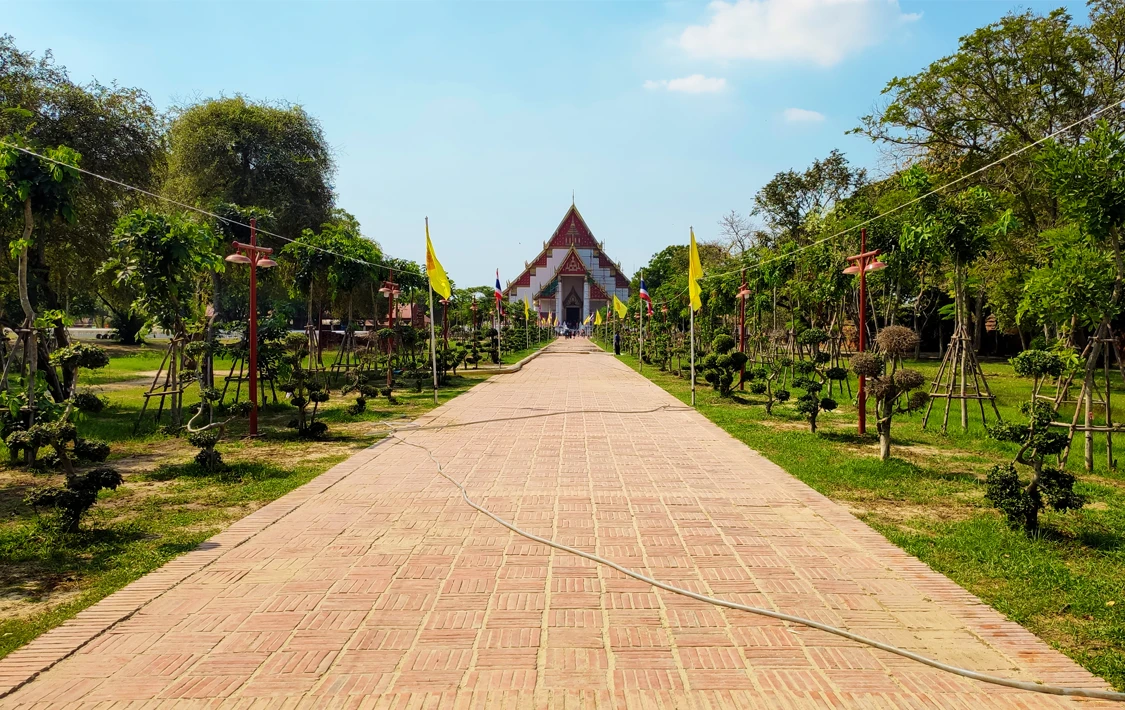
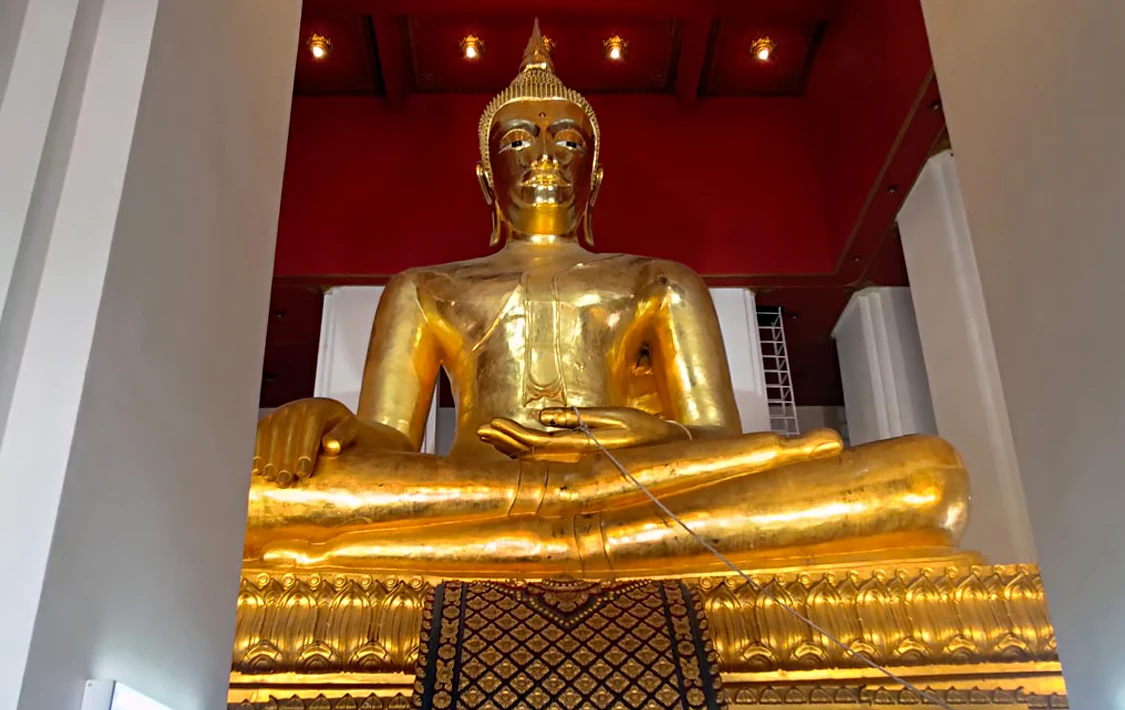
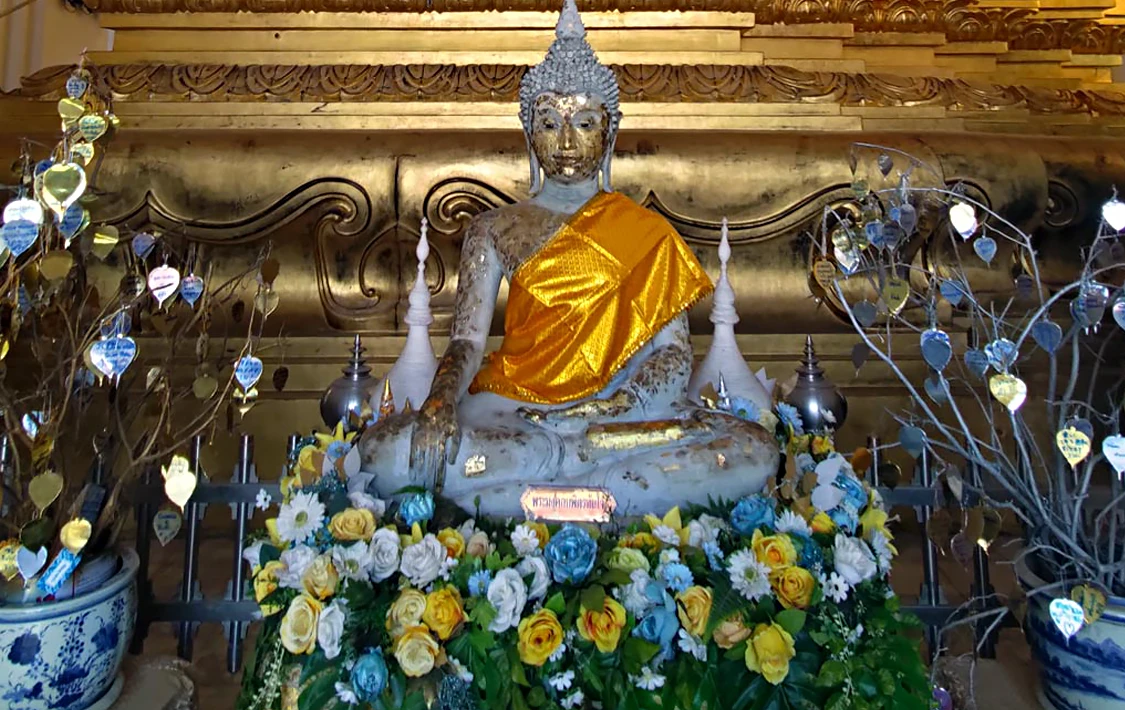
Located directly next to Wat Phra Si Sanphet, you’ll find Wihan Phra Mongkhon Bophit. Inside the restored mondop (cube-shaped building) stands an enormous Buddha statue made of brick and bronze, measuring 12.45 metres in height and 9.55 metres in diameter.
This impressive bronze Buddha is believed to have been cast during the reign of King Chairacha Thirat in 1538.
Struck by Lightning
During the reign of King Sua (1703–1709), lightning struck the roof of the mondop, causing the structure to catch fire. The burning roof eventually collapsed onto the Buddha statue, damaging its neck and causing the head of the bronze Buddha to fall to the ground.
Following the incident, King Sua ordered the entire structure to be demolished and commissioned the construction of a new ordination hall. Completing the new building took craftsmen more than two years.
Useful Information About the Temple
8. Wat Yaichaimonkhol Tempel Ayutthaya
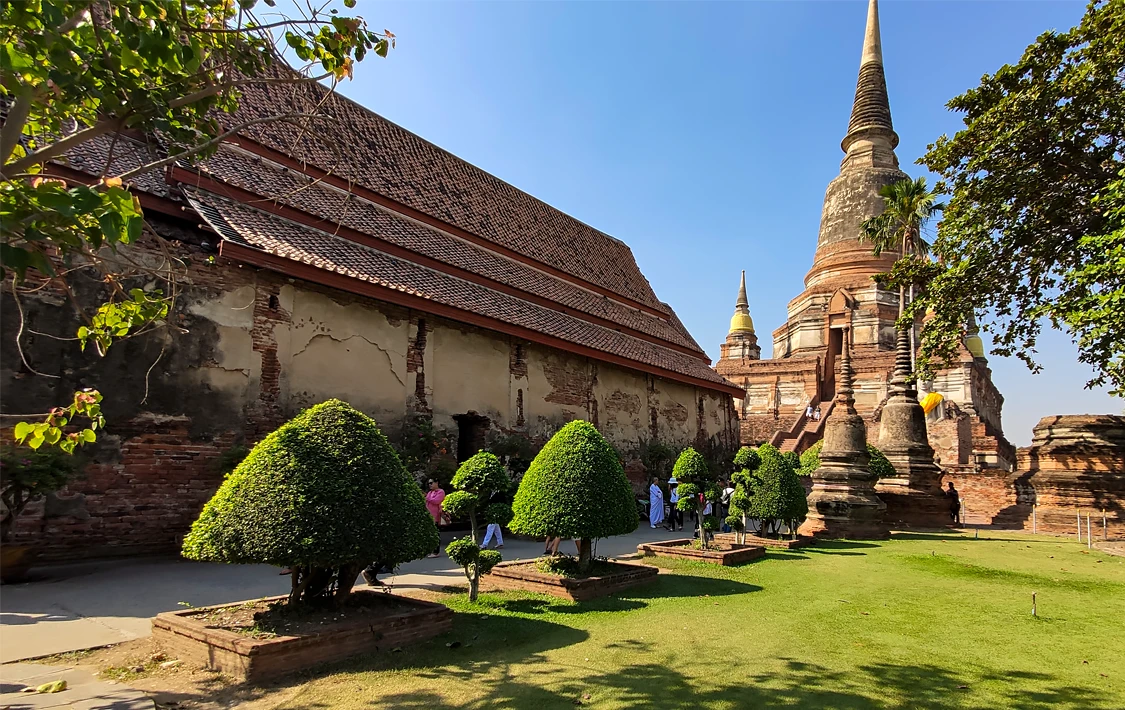


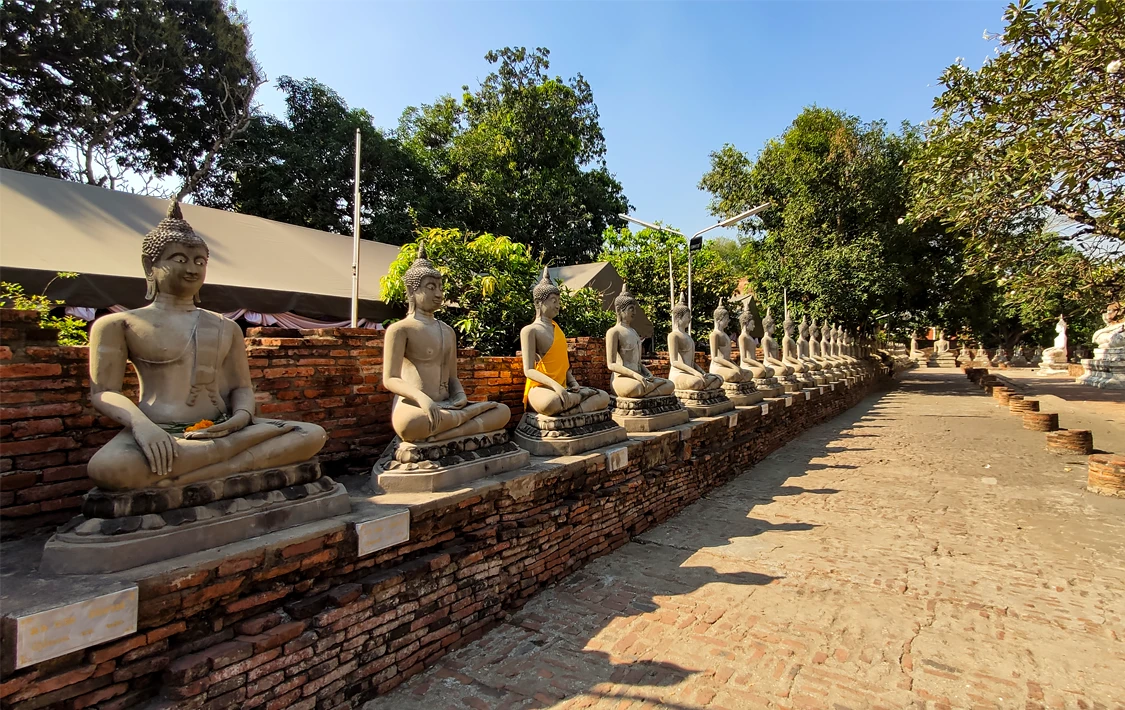

Wat Yai Chai Mongkhon was founded in 1357 by King Ramathibodi I, the first ruler of the Ayutthaya Kingdom. In the same year, two Ayutthayan princes, Chao Kaeo and Chao Thai, died from cholera.
The king ordered the princes to be buried at this site and commissioned the construction of a monastery with a sacred monument (stupa or chedi) and an ordination hall (viharn). The temple was also intended to serve as a residence for Buddhist monks returning from Ceylon (present-day Sri Lanka) after studying Buddhist teachings there.
The Main Attractions of Wat Yai Chai Mongkhon
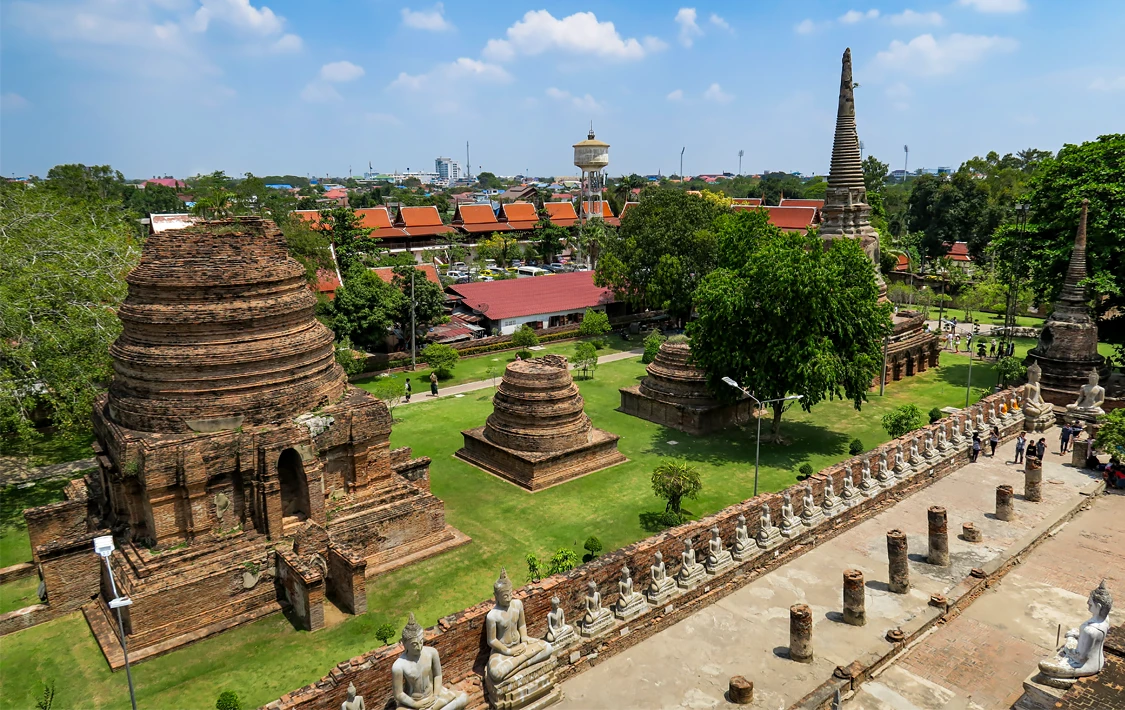
One of the temple’s highlights is the impressive 80-metre-high chedi, built upon a rectangular base. At each of its four corners stands a smaller chedi. On the eastern side, a long staircase leads down to a small crypt.
Originally, the central chedi was surrounded by a covered gallery, parts of whose foundation walls still remain today. Along these ruins, you’ll encounter numerous Buddha statues.
A short walk through the temple grounds also takes you past a large reclining Buddha statue, which represents another notable attraction within the complex.
Useful Information About the Temple
9. Wat Phutthai Sawan in Ayutthaya
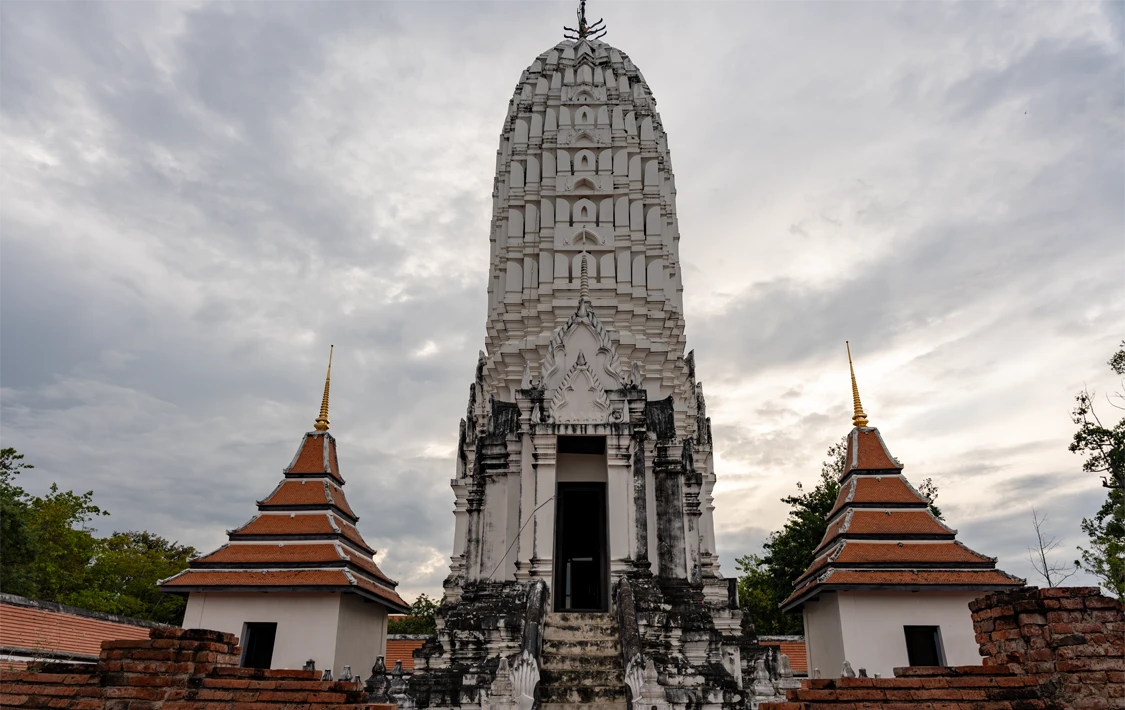
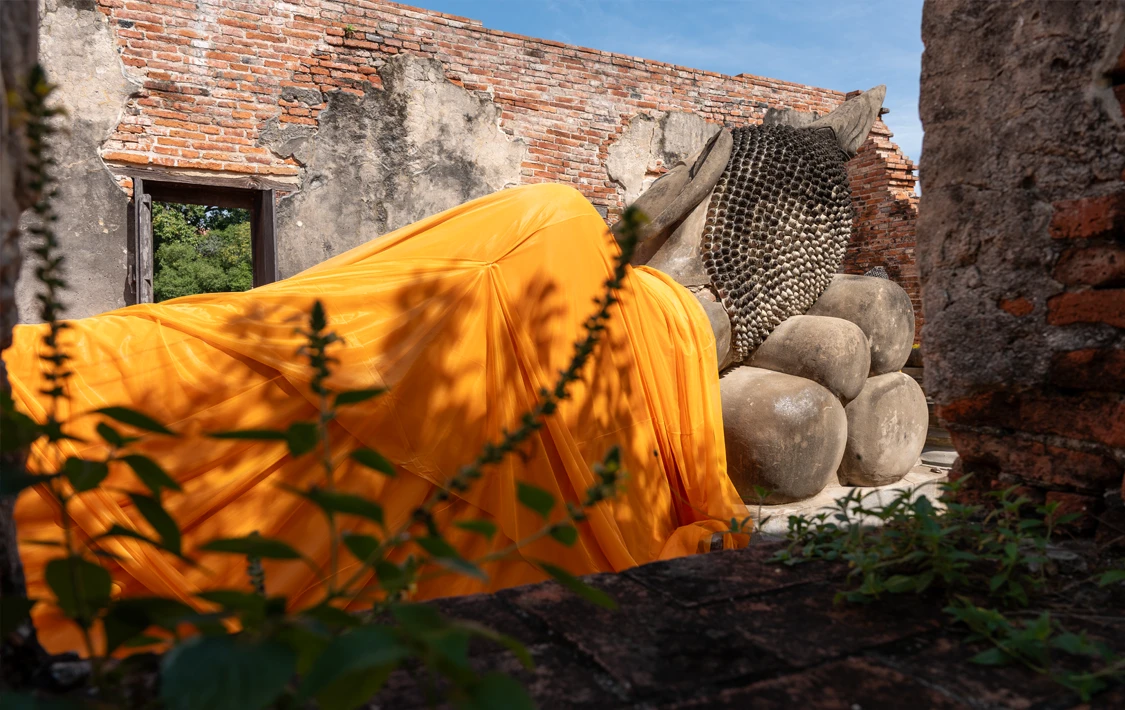
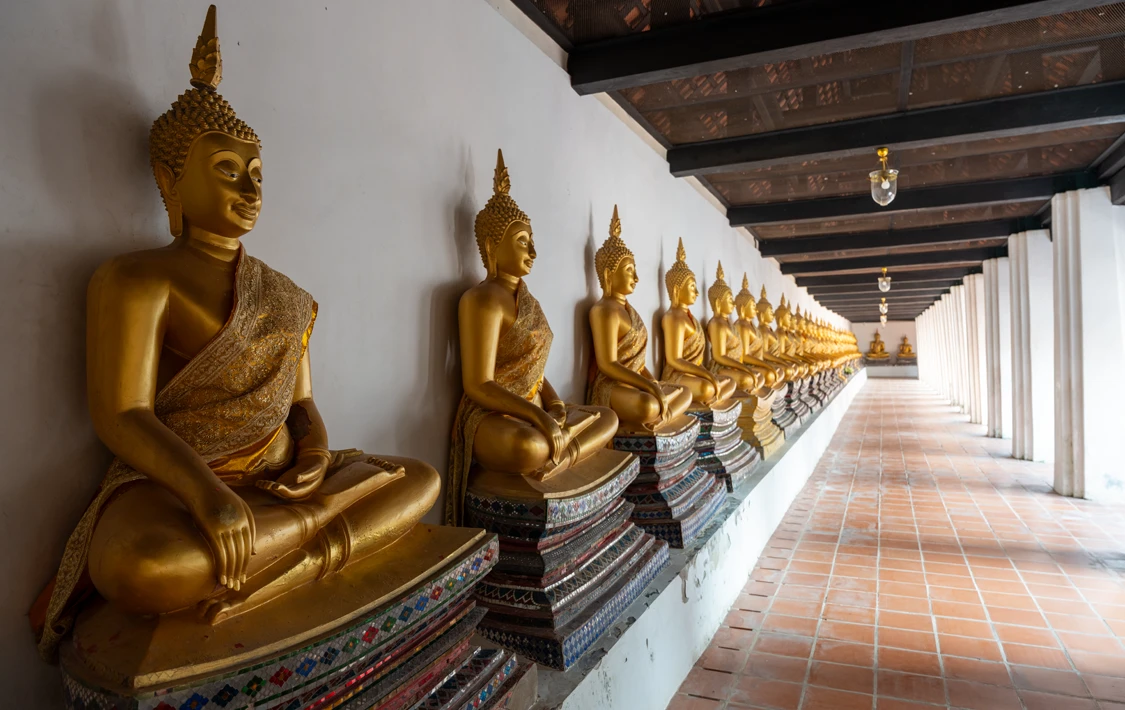
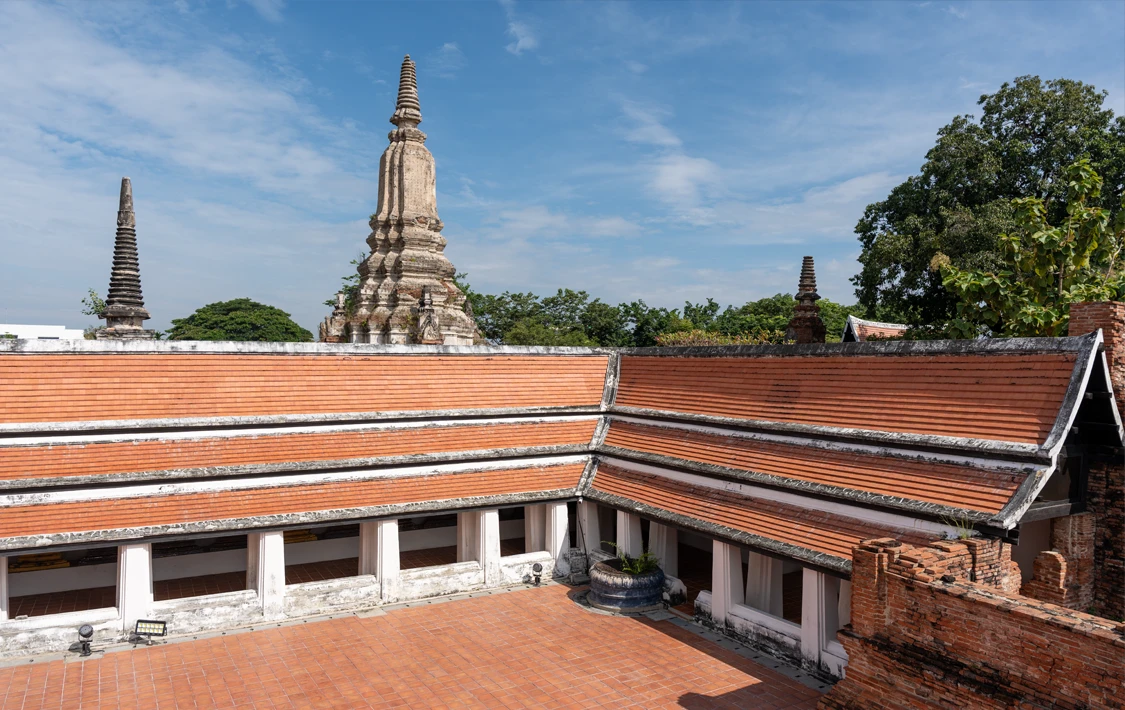
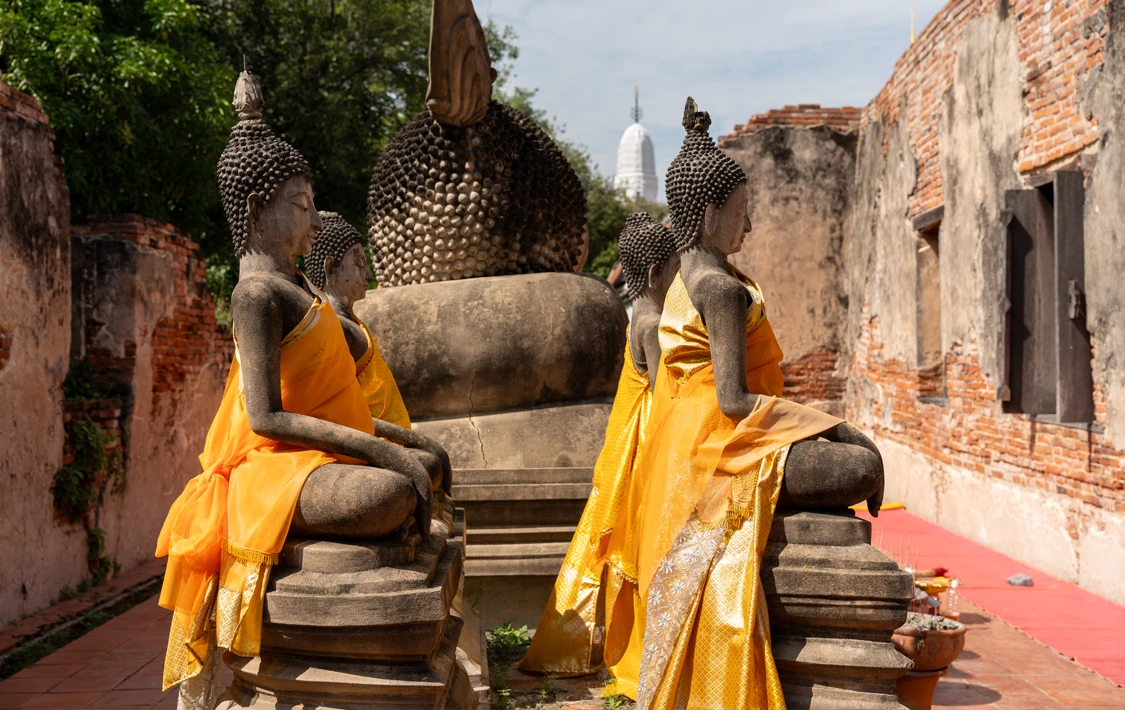
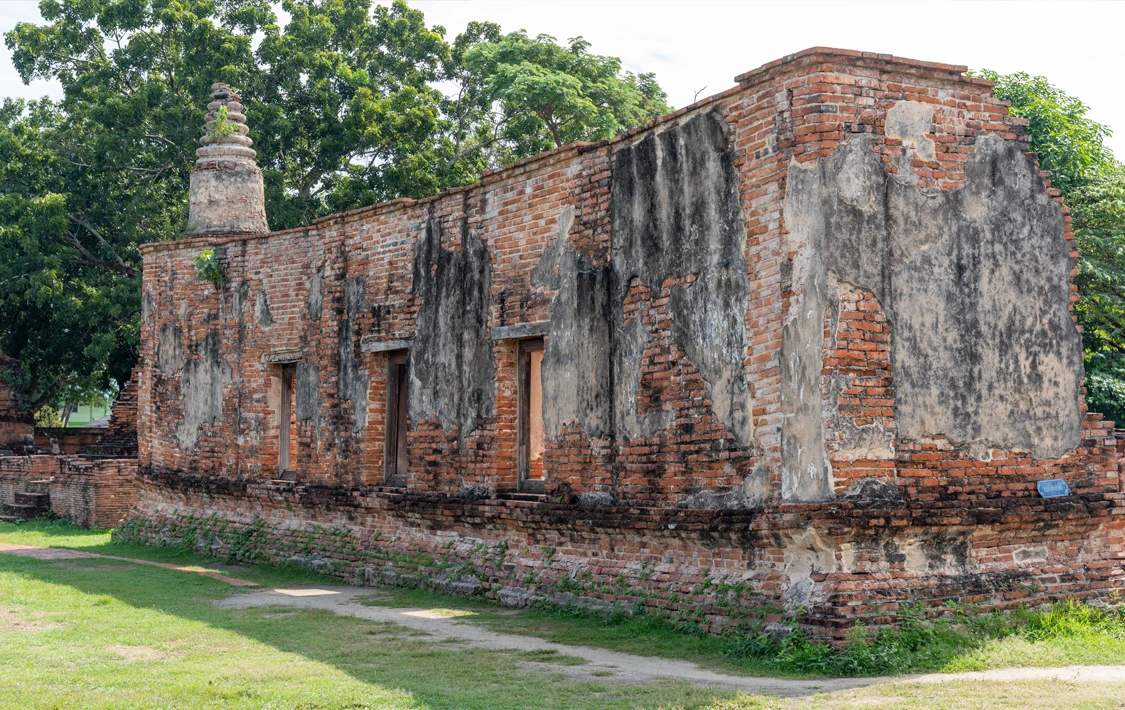
Wat Phutthai Sawan is one of the oldest yet most underrated temple complexes in Ayutthaya. While most visitors gather around the famous ruins in the historical centre, this temple offers a completely different atmosphere: peaceful, spacious, and almost meditative.
If you want to experience Ayutthaya beyond the main tourist spots, this temple should definitely be on your list.
History and Significance
The temple was founded in 1353, shortly after King U-Thong established Ayutthaya as the capital of the kingdom. It is believed that his original residence once stood on this very site.
The centrepiece of the complex is the striking white chedi built in Sinhalese style. Unlike many ruins in Ayutthaya, this structure remains remarkably well preserved, offering an authentic glimpse into the region’s historical architecture.
What to Expect During Your Visit
The central chedi is the main visual highlight and, due to its bright white appearance, almost feels surreal compared to Ayutthaya’s typical red-brick ruins. Around it, you’ll find ancient walls, smaller shrines, and open spaces inviting you to explore at your own pace.
One thing becomes immediately obvious: far fewer tourists. This allows you to wander through the complex quietly and appreciate the finer details.
Reclining Buddha
Another highlight is the reclining Buddha inside one of the temple buildings. The golden statue radiates a calm and peaceful atmosphere, making it a perfect place to pause for a moment.
Useful Information About the Temple
10. Wat Phu Khao Thong in Ayutthaya
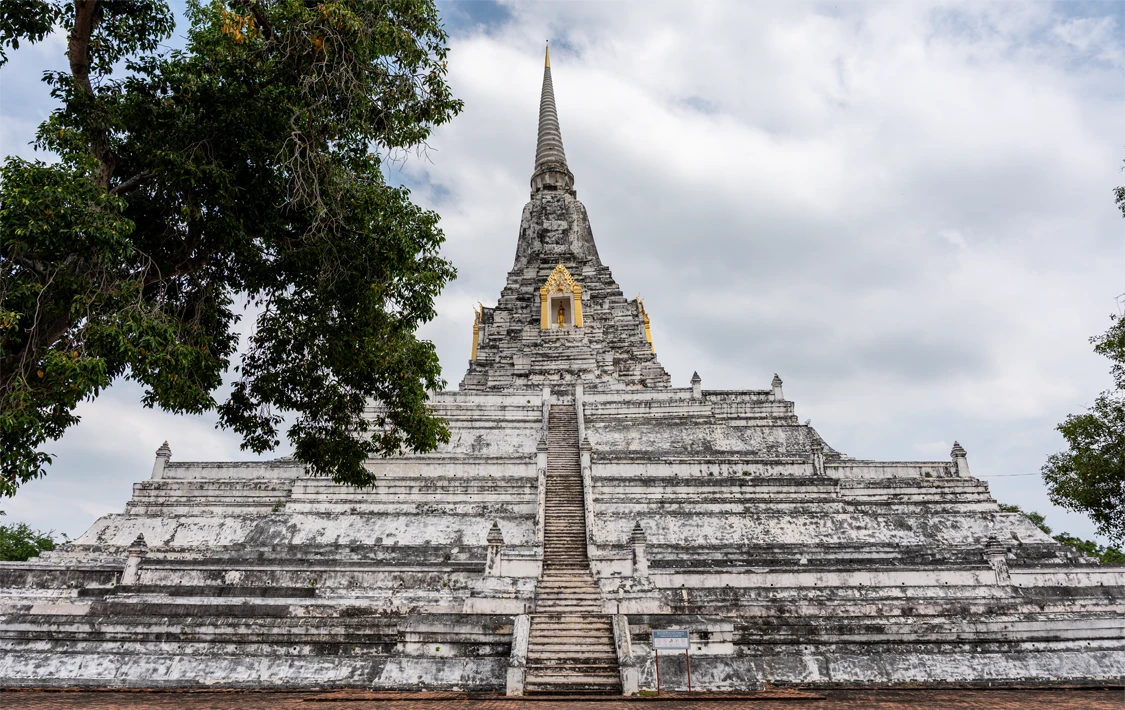
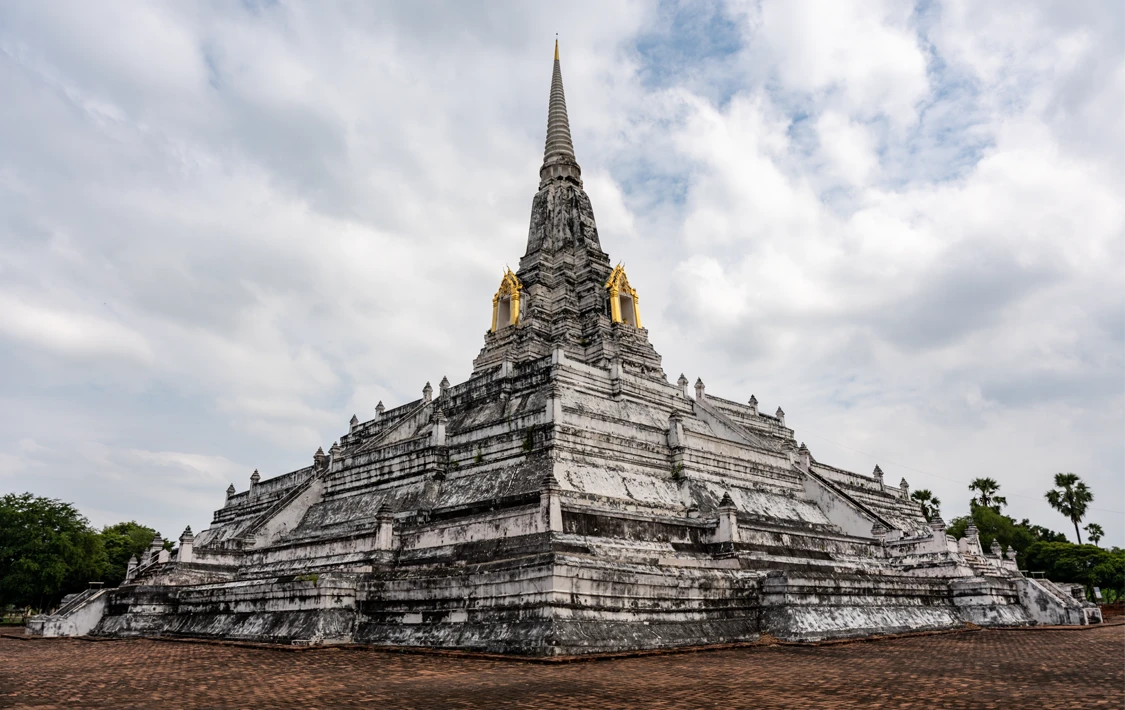
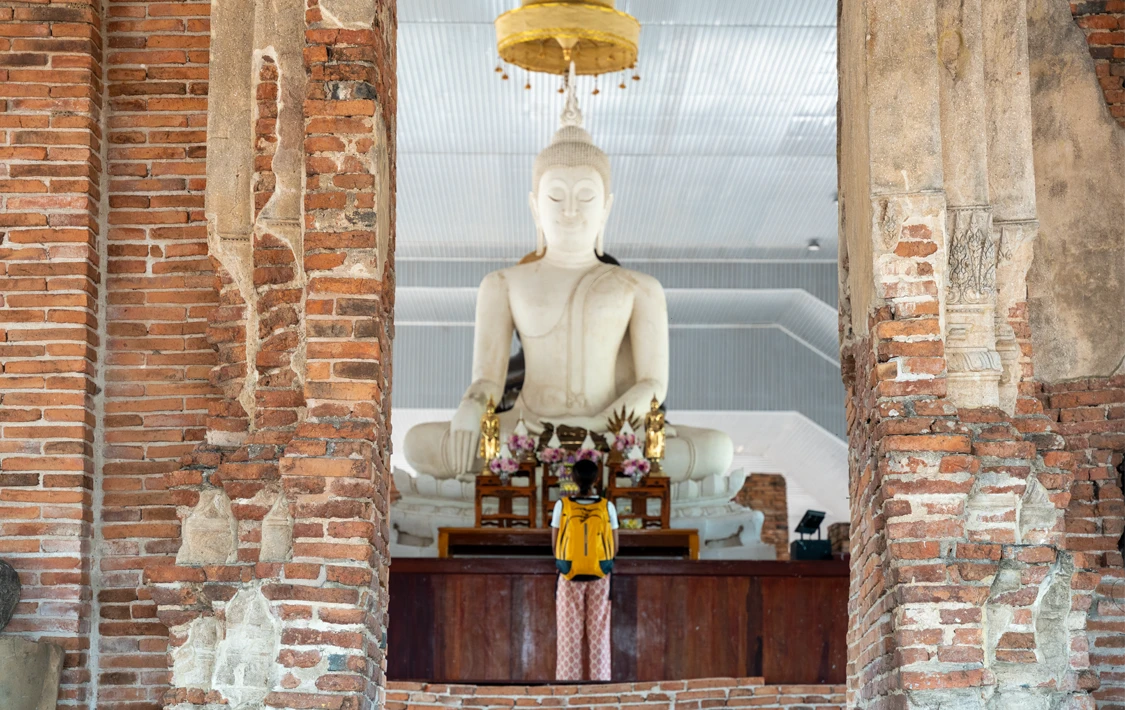
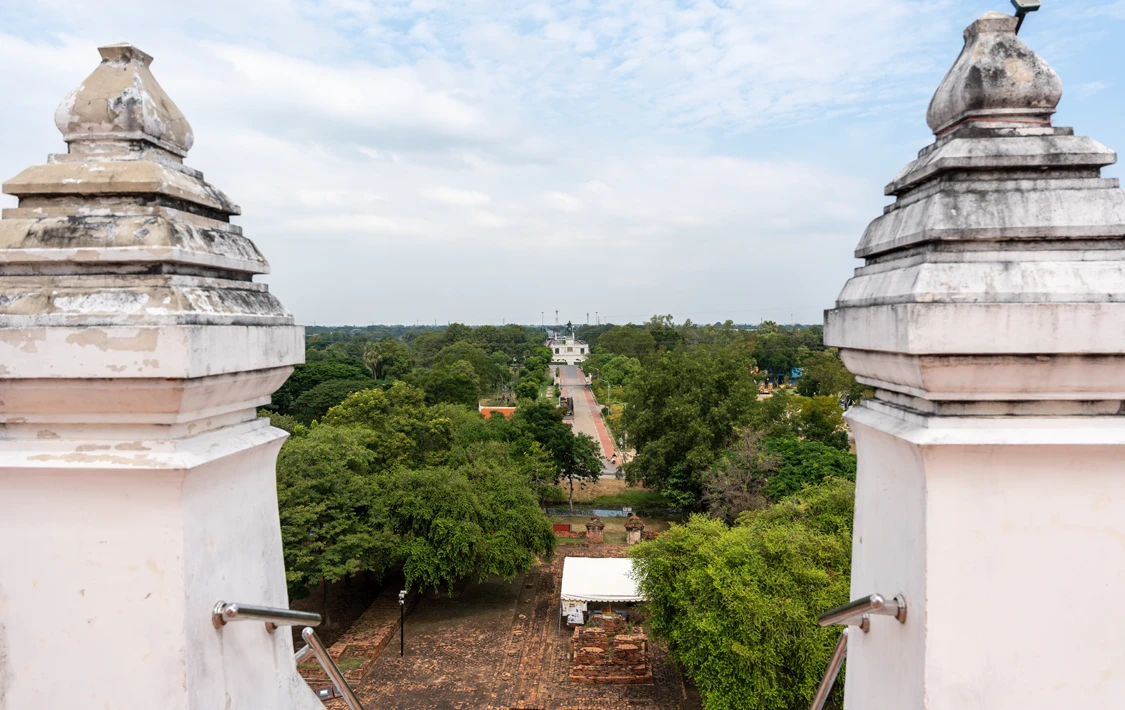
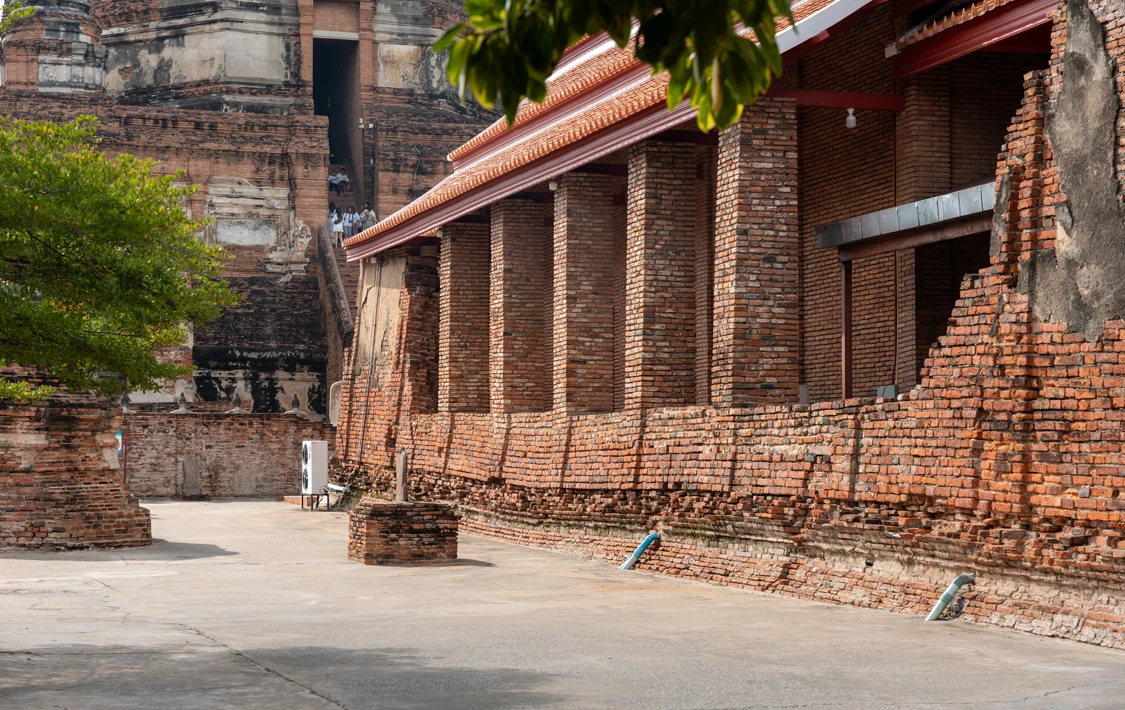
Wat Phu Khao Thong is one of those places in Ayutthaya that many visitors simply overlook, which is a shame. Because right here, you’ll find one of the most beautiful viewpoints in the region, combined with an impressive bright white temple structure.
If you’re searching for a peaceful spot away from the classic tourist attractions, you’ll love this place.
What Makes This Temple Special
The massive white chedi immediately catches your eye from a distance. Compared to Ayutthaya’s typical red-brick ruins, it feels almost minimalistic while still being incredibly striking.
Its clean and bright appearance also makes the temple especially appealing for photography, particularly under strong sunlight or during sunset.
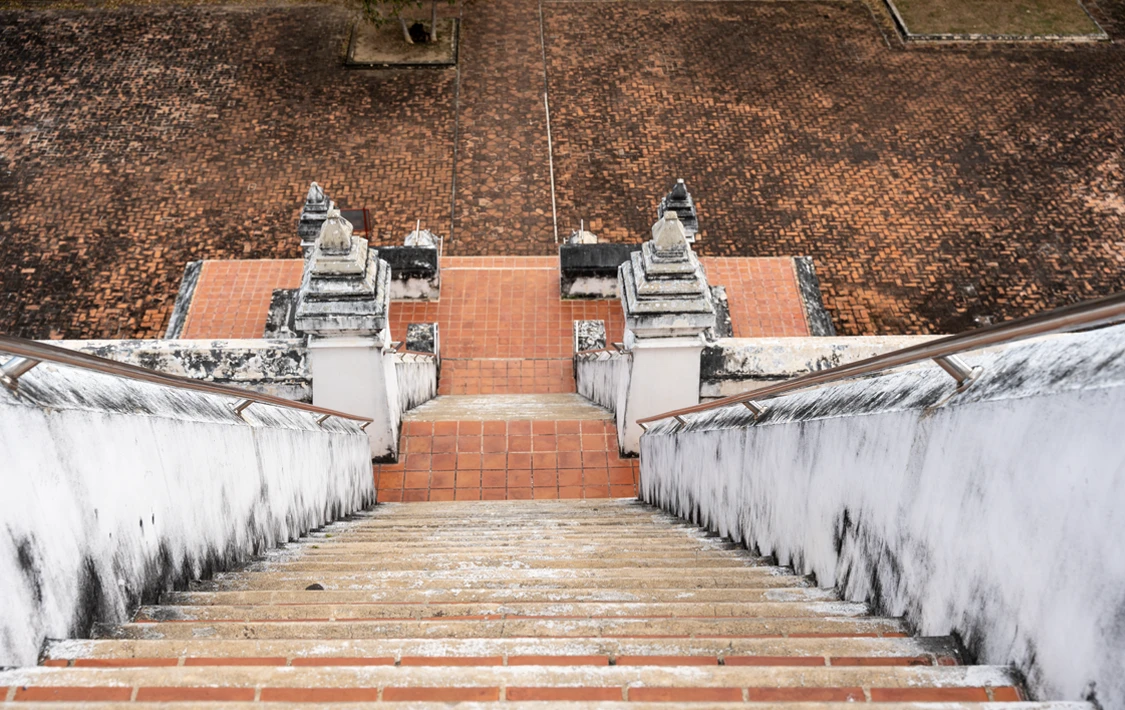
A true highlight: you can climb the chedi via steep staircases almost all the way to the top. Once there, you’ll be rewarded with surprisingly wide views across Ayutthaya’s flat landscape. No skyline, no crowds, just fields, temples, and tranquillity.
While many visitors focus on the famous temples in the historical centre, it often remains surprisingly quiet here. With a bit of luck, you may have large parts of the complex almost entirely to yourself.her auf die bekannten Tempel im Zentrum konzentrieren, ist es hier oft erstaunlich leer. Mit etwas Glück hast du die Anlage fast für dich allein.
Useful Information About the Temple
Hotel Recommendations for Ayutthaya
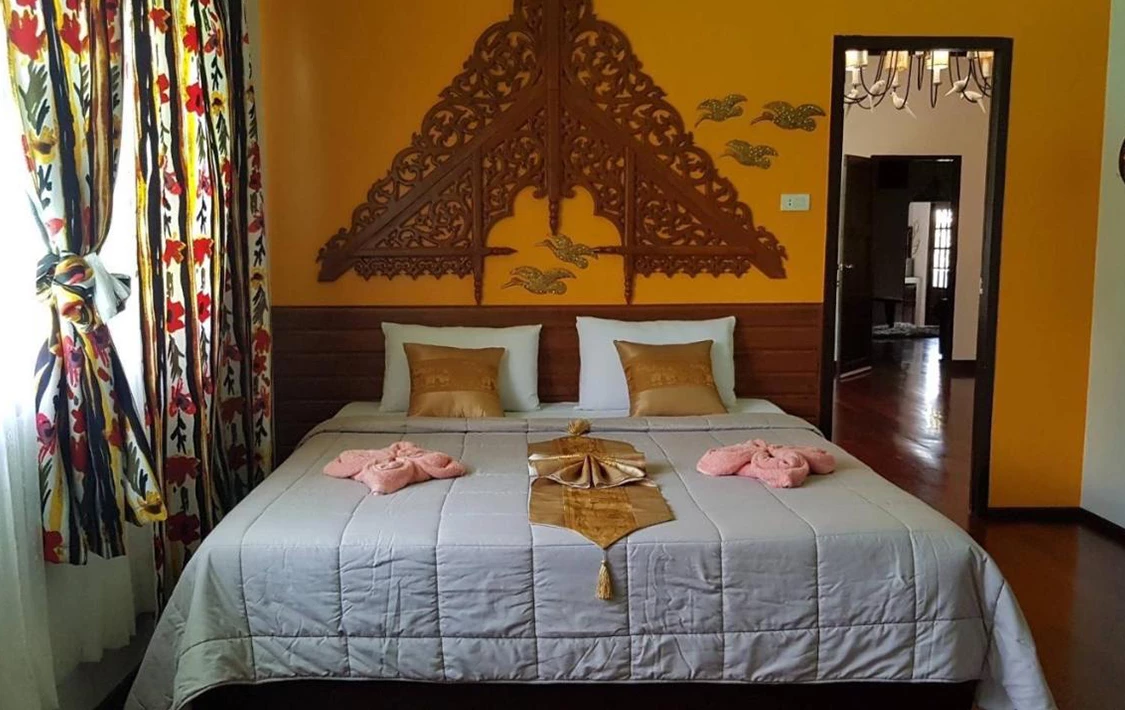
The Park Ayutthaya Resort And Spa – budget-friendly option with an excellent location
The Park Ayutthaya Resort And Spa is a cosy guesthouse designed in traditional Thai style and a great choice if you’re looking for an affordable stay in Ayutthaya. At the same time, it offers an ideal starting point for exploring the city’s famous temples.
The impressive Wat Mahathat and Wat Ratchaburana can both be reached within around 10 minutes on foot, making sightseeing particularly convenient.
Another advantage: the accommodation offers bicycle rentals, which is one of the best ways to explore Ayutthaya’s extensive temple complexes at your own pace.
If you’re searching for a budget-friendly hotel with a central location and authentic atmosphere, this accommodation is definitely worth considering.
Niwas Ayutthaya – A Great Alternative to The Park Ayutthaya Resort
Niwas Ayutthaya offers many of the same advantages as the accommodation mentioned above. It is another excellent option for budget-conscious travellers who still want a central location close to Ayutthaya’s main temple attractions.
The guesthouse provides a cosy atmosphere with traditional Thai elements and is well suited as a base for exploring the historical temple complexes of Ayutthaya.
A further benefit: bicycles can be borrowed free of charge, making it easy and affordable to discover Ayutthaya’s temples at your own pace.
If you’re looking for an affordable stay with good access to the city’s highlights, Niwas Ayutthaya is definitely worth considering.
One Dhatu Ayutthaya – Upscale Accommodation in a Prime Location
One Dhatu Ayutthaya is an upscale accommodation option with a prime central location, making it an excellent base for exploring the fascinating temples of Ayutthaya.
Unlike the previously mentioned hotels, One Dhatu stands out with its luxurious suites, offering guests a more exclusive and comfortable stay with stylish interiors and a refined atmosphere.
Its central location allows visitors to easily reach many of Ayutthaya’s historical temple complexes, making sightseeing both convenient and efficient.
If you’re looking for more comfort and a premium experience while discovering Ayutthaya, One Dhatu Ayutthaya is a great choice.
Getting to Ayutthaya – The Best Travel Options from Bangkok

Mit dem Zug
Ayutthaya is located around 80 kilometres north of Bangkok and can easily be reached by train, bus, minivan, taxi or organised tour. Depending on your budget and preferred level of comfort, there are several options available.
By train – Affordable and authentic
Travelling by train is one of the most popular and budget-friendly ways to reach Ayutthaya. Trains depart frequently from Don Mueang Station or Krung Thep Aphiwat Central Terminal Station in Bangkok.
The journey usually takes 40–60 minutes, depending on the train category, and tickets start from around €1. Tickets can be purchased directly at the station, and staff generally speak basic to good English.
By bus or minivan – Flexible and inexpensive
From Bangkok’s Northern Bus Terminal (Mo Chit), buses to Ayutthaya depart approximately every 30 minutes. Ticket prices are usually between 40–50 Baht, and the journey takes around 1.5–2 hours, depending on traffic conditions.
Another option is travelling by minivan, with departures from the Makkasan Terminal. Tickets cost around 150 Baht and can also be booked online.
By taxi – Comfortable but expensive
Taking a taxi is probably the most convenient, but also the most expensive, option. A one-way journey generally costs around 1,500 Baht. You can arrange a taxi through your accommodation, negotiate directly with drivers, or book transfers online in advance*.
Join an organised tour – Stress-free day trip
If you prefer a hassle-free experience, joining an organised day tour from Bangkok is a great option. Tours range from group excursions to private guided experiences, often including transport and visits to Ayutthaya’s main attractions.
Prices usually start from around €35 per person. You can find online tour options here*.
For travellers with limited time, an organised tour is often the easiest choice. If you prefer flexibility and lower costs, the train is usually the best option.
Best Time to Visit the Temples of Ayutthaya
The best time to visit Ayutthaya’s temples is between November and March. During these months, rainfall is at its lowest and temperatures are generally more pleasant, making it ideal for exploring the historical sites.
Climate: Finding the Perfect Balance
The dry season from November to February is considered the best period to visit Ayutthaya. During these months, you can expect warm but manageable temperatures, lower humidity and relatively little rain.
These conditions are ideal for exploring the ancient temple ruins and archaeological sites without being affected by extreme heat or heavy rainfall.
Festivals and Events: Experience Ayutthaya’s Cultural Side
If you want to experience Ayutthaya’s cultural heritage at its fullest, consider planning your trip around one of Thailand’s major festivals.
Events such as the Loy Krathong Festival in November or Songkran in April provide a unique opportunity to experience Thai culture and traditions, while seeing historical sites in a special atmosphere.
Avoid the Rainy Season: June to October
During the rainy season between June and October, Ayutthaya can experience heavy rainfall, occasionally leading to flooded streets and reduced visibility.
To enjoy the historical sites in more comfortable conditions and avoid weather-related disruptions, it is generally better to avoid travelling during these months if possible.
Avoid Extreme Heat: March to May
The period from March to May marks Thailand’s hot season, and Ayutthaya is no exception. Temperatures can become extremely high, making long walks through temple complexes more exhausting.
If you prefer cooler temperatures and lower humidity, travelling outside these months is recommended.
Recommendation
For the best overall experience, plan your Ayutthaya trip between November and February, when temperatures are more comfortable and weather conditions are most suitable for temple sightseeing.
Conclusion: Are the Temples of Ayutthaya Worth Visiting?
Although many of Ayutthaya’s temples are now little more than ruins and ancient remains, they have lost surprisingly little of their mystical atmosphere and historical charm.
In the once powerful capital of Ayutthaya, you’ll discover an impressive backdrop where the wealth, influence and grandeur of the former Siamese Kingdom can still be felt today. In my opinion, a visit to Ayutthaya is a valuable addition to any Thailand itinerary.
The ancient temple city reminds me a little of the world-famous Angkor Wat, although on a much smaller scale. Even though Ayutthaya’s temples are popular among tourists, the atmosphere generally feels more relaxed compared to Bangkok’s major attractions.
Visitors are spread across different temple complexes, allowing you to explore at your own pace in a calmer environment. At some sites, you may even find yourself almost alone among the ancient ruins, making the experience feel even more special.
For anyone interested in history, culture and impressive temple architecture, Ayutthaya is undoubtedly one of the most fascinating destinations in Thailand.
Do You Have Questions About Visiting Ayutthaya’s Temples?
Do you have any questions about this Ayutthaya temple travel guide? Feel free to ask in the comments section below. I’d be happy to help and answer your questions.
*Affiliate Disclosure:
Please note that this website contains affiliate links. This means we may receive a small commission if you purchase products or services through these links. The use of affiliate links does not affect the price you pay, and helps support this website in providing high-quality travel content and guides.